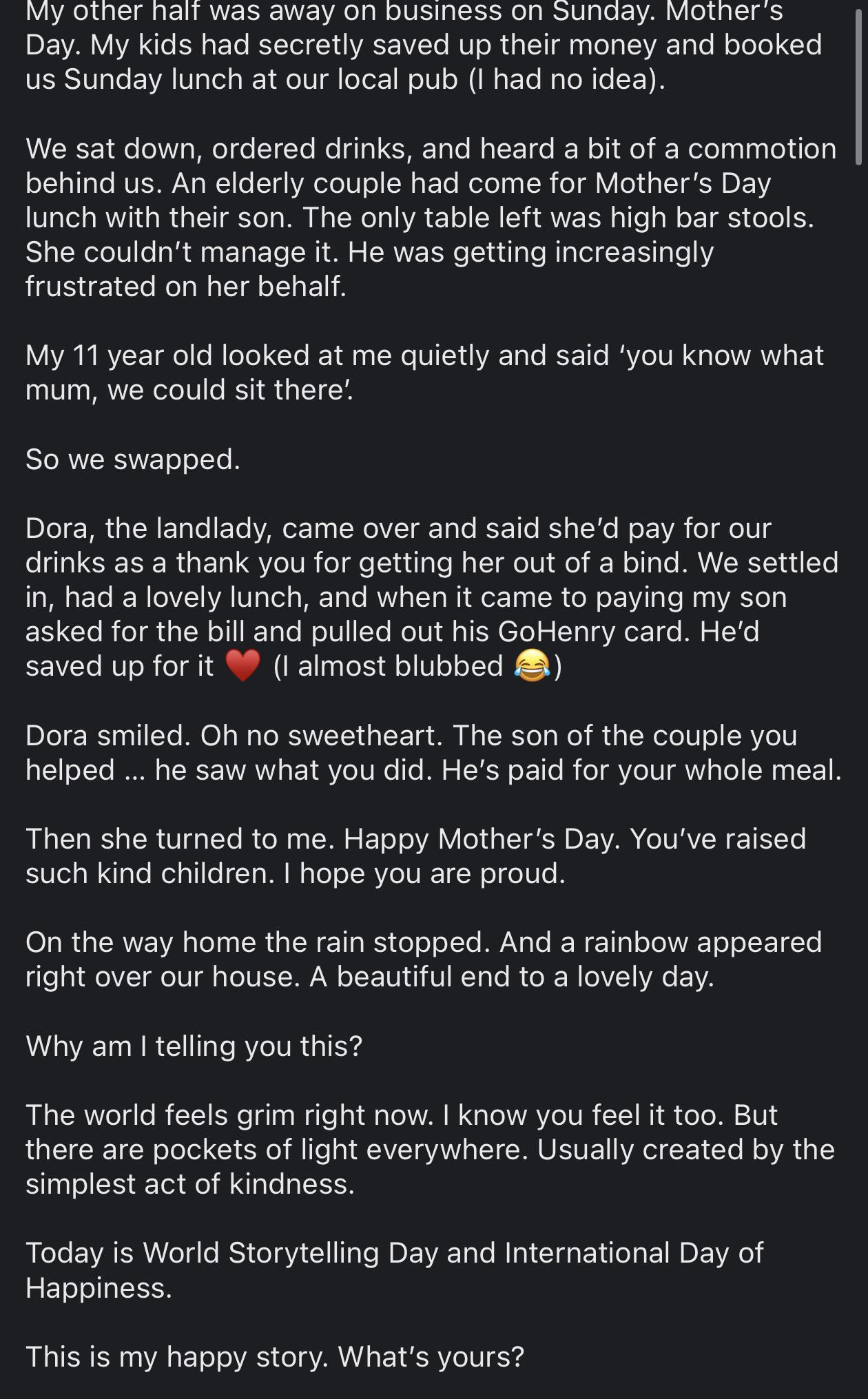
THE post, which circulates on LinkedIn and was subsequently recovered by the community r/LinkedInLunatics on Reddit, recounts a Mother's Day luncheon at an English pub with the architectonic precision of a medieval morality play—if the morality play had been composed by a system that understood virtue only as an escalation protocol and had never once witnessed a meal at which someone's card was declined, a child misbehaved, or a publican failed to deliver a homily. The author, whose name is not visible in the specimen as recovered, narrates a sequence of events so frictionless in their concatenation, so immaculate in their ascending register of goodness, that the reader is compelled not to disbelief—that would be uncharitable—but to a kind of structural awe at the engineering involved in removing from human experience every quality that makes it human.
The narrative proceeds as follows. The author's partner is away on business. It is Mother's Day. The children—whose ages are supplied with the specificity of a witness deposition—have secretly saved their money and booked a table at the local pub. This is the first act of goodness, and it is, in fairness, plausible: children do sometimes save pocket money, pubs do accept bookings, and the conjunction of the two, whilst heartwarming, does not strain credulity beyond its natural tolerances.
What follows, however, is an escalation so systematic that one begins to suspect the author has confused narrative with a staircase. An elderly couple arrives for their own Mother's Day lunch. There is only one table remaining, and it is furnished with high bar stools that the elderly woman cannot manage. Her son—introduced solely so that his frustration might serve as a foil to the author's child's magnanimity—grows visibly agitated. The author's eleven-year-old, with the quiet moral authority of a character in a Victorian improving tale, leans over and suggests they swap tables. They do. The elderly couple is rescued. The son's frustration is dissolved. No one spills anything. The transition is frictionless, which is to say, fictional.
Dora the landlady—and one notes the Christian name, deployed with the easy familiarity of a narrator who wishes you to understand that this pub is a community, that these people are known to one another, that warmth is the medium in which they move—comps the author's drinks as a gesture of thanks. This is the third act. The fourth arrives when the eleven-year-old, having previously demonstrated moral discernment beyond his years, now demonstrates financial independence beyond them, producing a GoHenry prepaid debit card to pay the bill. The brand name sits in the text with the comfortable specificity of product placement; the specimen does not earn the benefit of the doubt on matters of spontaneity. The author reports that she "almost blubbed," a verb that locates the narrative in a particular register of British sentimentality—sincere, colloquial, and aware of its own excess without being troubled by it.
The fifth kindness is structural rather than discrete: Dora returns to announce that the son of the elderly couple, having observed the table swap, has paid for the author's entire meal. The circuit of generosity is thus completed—the moral economy of the pub brought into perfect equilibrium. The sixth act is Dora's benediction: "Happy Mother's Day. You've raised such kind children. I hope you are proud." The publican has become the chorus, delivering the thematic summary that the narrative requires but that life, with its characteristic inelegance, rarely provides on cue.
And then—the rainbow. On the way home, the rain ceases, and a rainbow appears directly over the author's house. One must pause here, not because rainbows do not occur—they occur with meteorological regularity—but because the rainbow in this narrative performs a function so nakedly symbolic, so unburdened by ambiguity, that it reads less as a weather event than as a stage direction. Here the machinery of the narrative, having maintained a thin plausibility through six acts of ascending virtue, abandons all restraint and reaches for the pathetic fallacy with both hands. The sky itself has endorsed the proceedings.
The coda is instructive. The author reveals that the date of these events coincides with both World Storytelling Day and the International Day of Happiness—a coincidence retrieved with the particular enthusiasm of a narrator who has discovered that the calendar, too, can be made to ratify one's experience. The double observance is presented not as an amusing accident but as confirmation, as though the United Nations' designation of March 20th were a form of peer review. "This is my happy story," the author concludes. "What's yours?" The invitation is the tell: the story has been shaped, from its first sentence, as a prompt—a call for reciprocal testimony in a chain of witnessed goodness that extends, theoretically, to the horizon of the platform's engagement metrics.
The forensic assessment holds that the specimen is probably not machine-generated, and one is inclined to accept this judgment, though not without observing that the distinction has become rather less clarifying than one might wish. The prose is human. The structure is not. No algorithm arranged these seven kindnesses in their ascending order, but something did—something that operates with algorithmic logic whilst residing in a human being and understands narrative not as the arrangement of events in their true complexity but as the systematic elimination of everything that might impede the production of feeling. The author has not fabricated the events, perhaps. But she has performed upon them an operation that is more unsettling than fabrication: she has removed from them every trace of friction, contingency, and imperfection—every quality by which we recognise lived experience as lived—and produced instead a mechanism. The mechanism works. The reader feels. And what the reader feels is, precisely, nothing, because the feeling has been so perfectly engineered that it arrives without resistance, passes through without leaving residue, and dissipates without consequence, like a rainbow over a house.
Specimen: Screenshot of a LinkedIn post recounting a Mother's Day pub outing featuring seven sequential acts of kindness culminating in a rainbow. Recovered from Reddit, r/LinkedInLunatics, March 2026. The post concludes by noting the date coincides with World Storytelling Day and International Day of Happiness, a conjunction that the author regards as meaningful and the reader may regard as diagnostic.