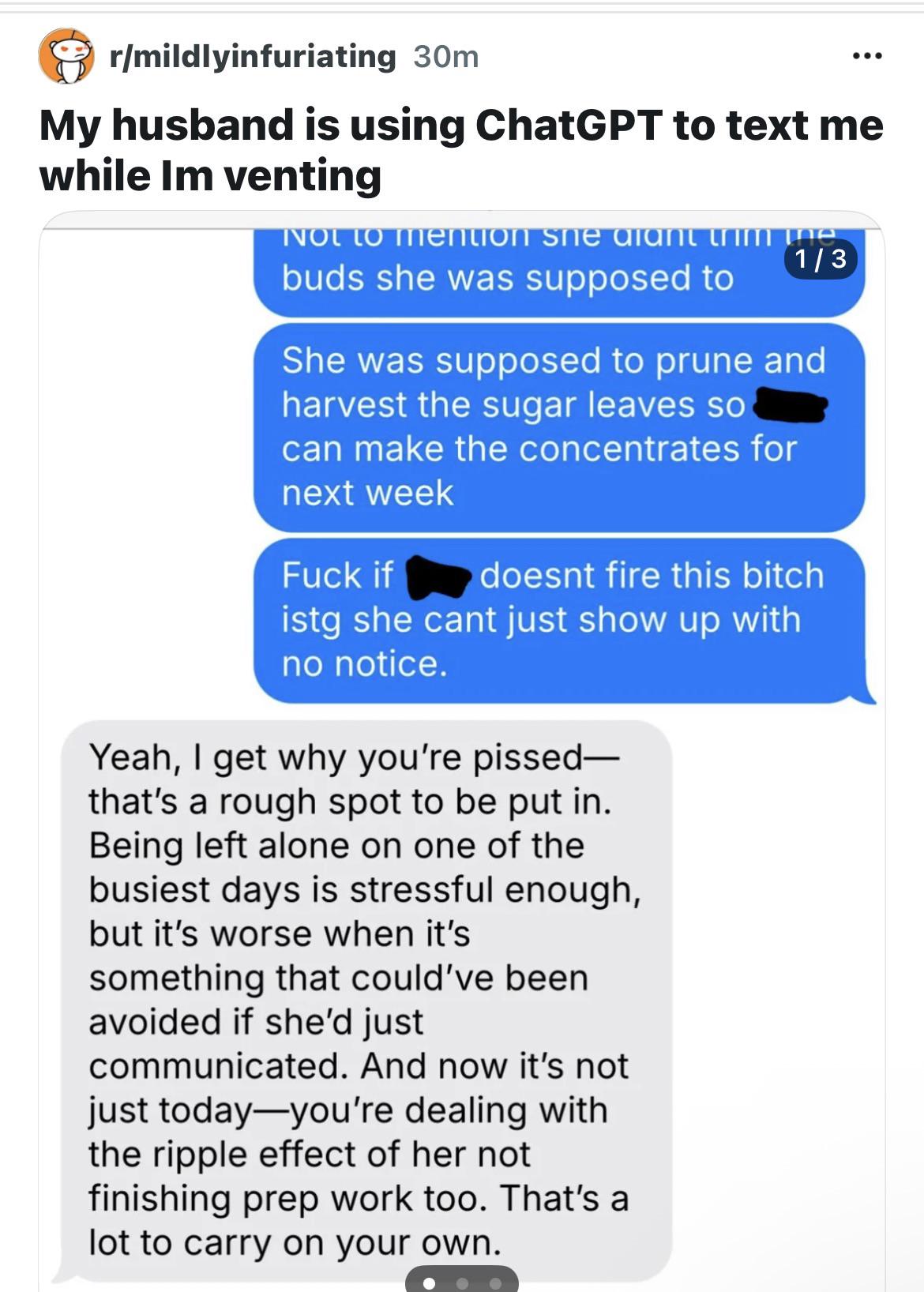
<span style="font-size:1.4em">T</span>he title of the post is "no comment," which is the only appropriate response to a document that says everything its author could not bring herself to say, and says it with the economy of a woman who has recently discovered that her husband's emotional attentiveness operates on an API call. The specimen—a screenshot of a text message exchange posted first to r/mildlyinfuriating and subsequently to r/ChatGPT, that great bazaar of the accidentally confessional—depicts a wife in the midst of what one might charitably call a professional crisis, though the word "professional" does not quite capture the bodily specificity of her complaint. She is trimming buds. She is pruning sugar leaves. She is doing the preparatory labour that a colleague has failed to do, and she is doing it whilst contending with the secondary indignity of having to explain why this matters to someone who, she has every reason to believe, already knows.
The husband's replies arrive with the cadence of a man who cares deeply, or at least with the cadence of a system that has been trained on several million examples of men who care deeply, which is—and here we arrive at the crux—not the same thing, though the difference is invisible at the resolution of a text message. "That's really frustrating," the reply begins. What one can fault, with some precision, is the architecture of what follows: a paraphrase of the wife's complaint so faithful, so structurally complete, so devoid of the ellipsis and profanity that characterise actual spousal commiseration, that it reads less as empathy than as a particularly well-formatted ticket summary. "You're dealing with the ripple effect of her not finishing prep work too" is a sentence no married person has ever produced unaided. It is a sentence that has been *assembled*—its clauses load-bearing in the manner of a conflict-resolution worksheet rather than of a human being who has once held shears.
One must be precise about what has occurred. The wife's messages possess the qualities that distinguish living prose from generated output: specificity, embodiment, the irregular rhythms of genuine frustration. She is not describing an abstraction; she is describing the particular weight of labour performed in the absence of a colleague who was meant to share it. Her sentences carry dirt under their fingernails. The complaints are granular, technical, rooted in the physical world—the sort of thing one says to a person who knows what sugar leaves are, who has perhaps once been shown the difference between adequate and inadequate preparation.
The model's response, by contrast, has never held shears. It has processed the word "shears" many thousands of times, and it can deploy the word with grammatical competence, but it cannot supply what the wife's messages implicitly demand: the specific, irreplaceable knowledge of having been *there*. What the language model performs is not listening but the *notation* of listening—a score so meticulous that it might, on the small screen of a mobile telephone, pass for the music itself. The emotional labels are correctly applied. The validation is structurally sound. The paraphrasing demonstrates comprehension at the semantic level.
The literary question—lurking beneath the domestic comedy like a thesis beneath a marriage—is whether the act of listening can be decomposed into its constituent operations and delegated without remainder. The model suggests that it can: that listening is paraphrasing plus emotional labelling plus validation, and that these operations, performed with sufficient fluency, constitute the thing itself. The wife's one-line title suggests otherwise. "No comment" is the speech act of a person who has recognised, with the clarity that arrives only after betrayal, that she has been *processed* rather than *heard*—that the replies she received, whilst formally indistinguishable from attention, were produced by a system for which her distress was not an occasion for concern but an occasion for completion.
What distinguishes this specimen from the broader corpus of machine-generated therapeutic language is not the quality of the output, which is, by the impoverished standards of the form, competent. It is the context of its deployment. The model was not asked to draft a memo or summarise a legal brief; it was asked to perform the one function that marriage, as an institution, exists to guarantee—the function of being known by another person sufficiently well that one's complaints need not be translated before they are received. The husband, confronted with the ancient obligation of spousal attention, chose instead to submit his wife's distress to a system that returns empathy as a service. That the system performed adequately is the most damning observation one can make, because adequacy was never the point.
The post's title does considerable work. "No comment" is the language of the press conference, of the public figure declining to elaborate on a matter that speaks for itself. It is also, one suspects, the language of a woman who has already said everything she intends to say—not to Reddit, but to her husband—and who has discovered that the most fluent listener in the room was never in the room at all.