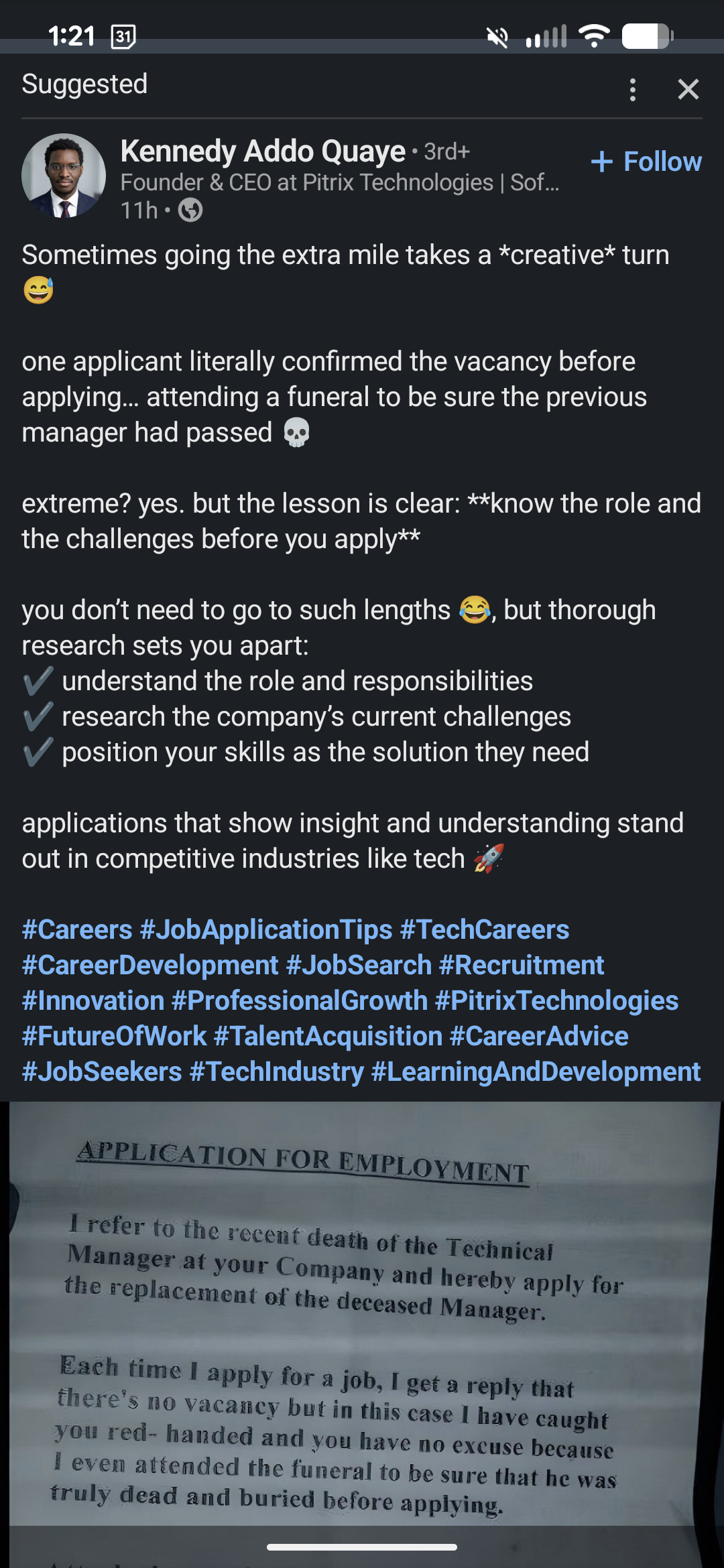
DECK: *Founder and CEO presents machine-rendered handwriting specimen as documentary proof of apocryphal parable in which job applicant verifies vacancy by attending burial of predecessor.*
BYLINE: By Silas Vane / Business Correspondent, Slopgate
The post, which appeared on LinkedIn on the account of one Kennedy Addo Quaye, identified in the platform's credentialing apparatus as Founder and CEO of Pitrix Technologies, proceeds as follows. A young professional, having learned of the death of a company's general manager, attends the funeral. At the graveside, he approaches the CEO to ask whether the deceased's position might now be filled. The CEO, rather than recoiling, is impressed. The applicant is hired. The moral, which Mr. Quaye delivers with the serene confidence of a man who has confused pathology with initiative, is that opportunity belongs to the bold.
Beneath the anecdote—offered without attribution, without sourcing, without the faintest tremor of self-consciousness—Mr. Quaye has attached an image. It purports to be the applicant's handwritten letter of interest, composed in a flowing cursive hand on unlined paper. "Dear Sir," it begins, and continues through several lines of respectful supplication. The letter is a forgery. Not a forgery of an existing document, which would require at least the raw material of reality, but a forgery of a document that never existed, manufactured to lend physical provenance to a story that did not happen. The cursive exhibits the uniform-yet-irregular stroke weight characteristic of image-generation models attempting handwriting—each letter individually plausible, the ensemble subtly wrong in the manner of a wax museum where every figure has the same pulse rate.
What we are asked to admire, then, is a structure of fabrication so layered that it achieves a kind of negative integrity. The anecdote is apocryphal. The letter is artificial. The lesson is monstrous. And the entire production is offered to LinkedIn's professional community as wisdom.
It is worth pausing to consider the economics. LinkedIn's engagement algorithm, like all such systems, is agnostic regarding truth. It measures interaction—likes, comments, shares, the time a user's thumb hovers over a post before scrolling onward. Mr. Quaye's parable, whatever its relationship to events in the physical world, is optimized for this measurement. It contains conflict (death, ambition), resolution (hiring), and a moral (be bold). That the moral is indistinguishable from sociopathy is, from the algorithm's perspective, a feature. Outrage is engagement. Disbelief is engagement. The seven hundred professionals who, at the time of recovery, had reacted with approval—that, too, is engagement.
The hashtags appended to the post deserve their own accounting. Mr. Quaye has furnished twelve: #TalentAcquisition, #FutureOfWork, #LearningAndDevelopment, #ProfessionalGrowth, #LeadershipDevelopment, #Networking, #CareerAdvice, #JobSearch, #HiringTrends, #WorkplaceCulture, #Motivation, and #SuccessMindset. These function less as metadata than as incantation—a ritual invocation of the platform's categorical deities, each hashtag a small candle lit before the altar of algorithmic distribution. Whether Mr. Quaye believes in these categories or merely tithes to them is a distinction without a difference.
The broader pattern is worth the attention of anyone who monitors professional networks as leading indicators of labor-market sentiment. LinkedIn has become, over the past several years, the site of an extraordinary economic phenomenon: the industrialization of apocryphal professional folklore. Stories of implausible hiring, of CEOs who test applicants through secret trials, of janitors revealed to be billionaires—these circulate not as entertainment but as strategy. They are presented, and received, as actionable intelligence about how careers actually function. The production values have escalated accordingly. Where once a LinkedIn fabulist needed only text, the competitive landscape now demands props. Mr. Quaye's machine-generated letter is, in this context, a capital investment: the marginal cost of fabricating documentary evidence having fallen to approximately zero, the rational actor fabricates.
One notes that the deceased general manager, whose death serves as the inciting event of Mr. Quaye's parable, receives no eulogy, no name, no acknowledgment beyond his utility as a plot device. He has died so that a stranger might attend his funeral and ask for his job. In Mr. Quaye's telling, this is not ghoulish but aspirational. The dead man's contribution to the narrative is to have vacated a position. His contribution to the platform's engagement metrics is, presumably, zero.
The specimen was recovered from the subreddit r/LinkedInLunatics, a community of approximately eight hundred thousand members whose editorial function is the curation and annotation of material that LinkedIn's own moderation apparatus declines to flag. That an informal, unpaid collective performs the quality assurance that a $26.2 billion Microsoft subsidiary does not is itself a market signal of some clarity.
Mr. Quaye's post remains live. The position, one assumes, has been filled.