DECK: *German-language founder deploys full apparatus of personal branding to produce machine-generated headshot bearing legend "Men 100" on the one day of the calendar year nominally reserved for the opposite sex.*
BYLINE: By Silas Vane / Business Correspondent, Slopgate
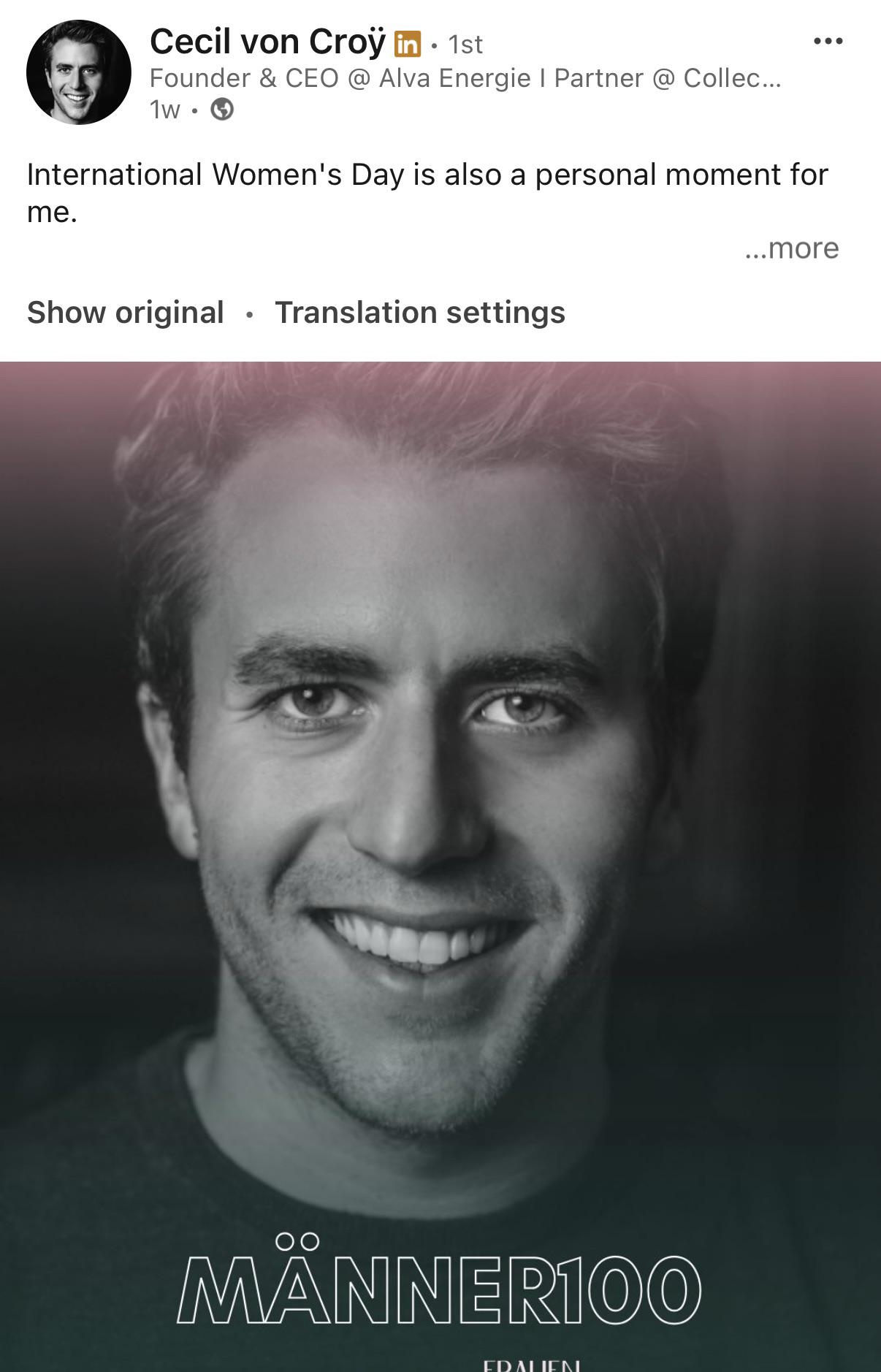
The specimen is a LinkedIn post by one Cecil von Croÿ, identified in the platform's credentialing apparatus as Founder & CEO at Alva Energie and Partner at an entity whose name begins with "Collec—" before the interface truncates it, as LinkedIn so often truncates things that might otherwise prove illuminating. The post, published on or around International Women's Day, features a machine-generated black-and-white portrait of Mr. von Croÿ overlaid with the text "MÄNNER100"—German for "Men 100"—and bears the caption "On the Women's Day I want to support #Men100." It was recovered from the subreddit r/LinkedInLunatics, which functions as a kind of EPA Superfund registry for the platform's most conspicuous emissions.
Let us begin with the portrait itself, as any analyst of capital flows must begin with the balance sheet. The image exhibits the standard hallmarks of artificial intelligence generation: skin of preternatural smoothness, as though the subject had been dipped in resin; lighting that is symmetrical in a manner achievable in no physical studio; teeth of implausible uniformity; and the characteristic luminescence that machine-generated portraiture confers upon its subjects—a face unburdened by pores, by weather, by the passage of time, by any of the indignities that accrue to faces required to exist in three dimensions. It is, in short, the face of a man as a man might wish to appear on the cover of a magazine that does not exist, produced by a technology that flatters without being asked and cannot be taught to stop.
The economics here deserve careful examination. Mr. von Croÿ is not a marginal user. He is a founder and chief executive—a man who occupies, by his own account, the uppermost stratum of at least two organizational hierarchies. The decision to deploy artificial intelligence in the production of a self-aggrandizing headshot on International Women's Day was not made from the periphery of the professional economy but from something very near its center. This is not a bug report. This is a feature working as designed.
The platform incentive structure that produced this specimen is by now well documented in the literature, if one may call it literature. LinkedIn rewards engagement. Engagement is agnostic as to valence. A post that provokes indignation circulates with the same velocity as a post that provokes admiration, and with considerably greater reliability. The algorithm cannot distinguish between a reaction that means "this is inspiring" and one that means "I cannot believe what I am seeing," nor does it have any commercial incentive to learn the difference. Mr. von Croÿ's post, whatever its intent, is optimized for exactly this indifference. It is engagement-neutral ordnance.
The result is a species of production now so common on the platform that it may deserve formal taxonomic classification: the self-centering commemorative post. The mechanism is simple. A day exists on the calendar to honor a group to which the poster does not belong. The poster marks the occasion by publishing material about himself. The inversion is total and, within the logic of the platform, entirely rational. International Women's Day becomes, through the alchemy of personal branding, an occasion for a man to commission a machine-generated portrait of himself and brand it with a hashtag celebrating men. The irony is not a failure. The irony is the product.
The German-language element introduces a jurisdictional wrinkle that is finally cosmetic. LinkedIn renders all such productions into a single undifferentiated market. A founder in Düsseldorf and a founder in Denver operate under identical incentive architectures, produce identical artefacts, and receive identical engagement metrics in return. The platform is, in this narrow sense, the single market that the European Union has spent decades attempting to build.
One notes, as a matter of professional interest, the hashtag construction. "#Men100" aspires to the cadence of a Forbes or Fortune ranking—a listicle of the significant, a roll call of consequence. That it appears to be a designation Mr. von Croÿ has either invented or adopted for the purpose of this post does not diminish its ambition. It is the creation of a category in which one is, by construction, included. This is not vanity. Vanity implies awareness of an audience. This is something closer to infrastructure—the quiet, competent laying of pipe.
The broader market observation is this: artificial intelligence has reduced the cost of self-mythologization to zero. A glossy magazine cover once required a photographer, a stylist, a publication willing to dedicate its cover, and—most expensively—some prior accomplishment sufficient to justify the undertaking. The machine requires only a prompt. The barriers to entry have been eliminated, and as in any market where barriers to entry collapse, the inevitable result is oversupply. LinkedIn is now saturated with founders gazing into algorithmic middle distances, their jawlines sharpened by neural networks, their achievements implied by typography. Mr. von Croÿ's specimen is distinguished only by its timing, which elevates an ordinary act of self-promotion into something approaching structural commentary.
The market, as ever, has priced this in.