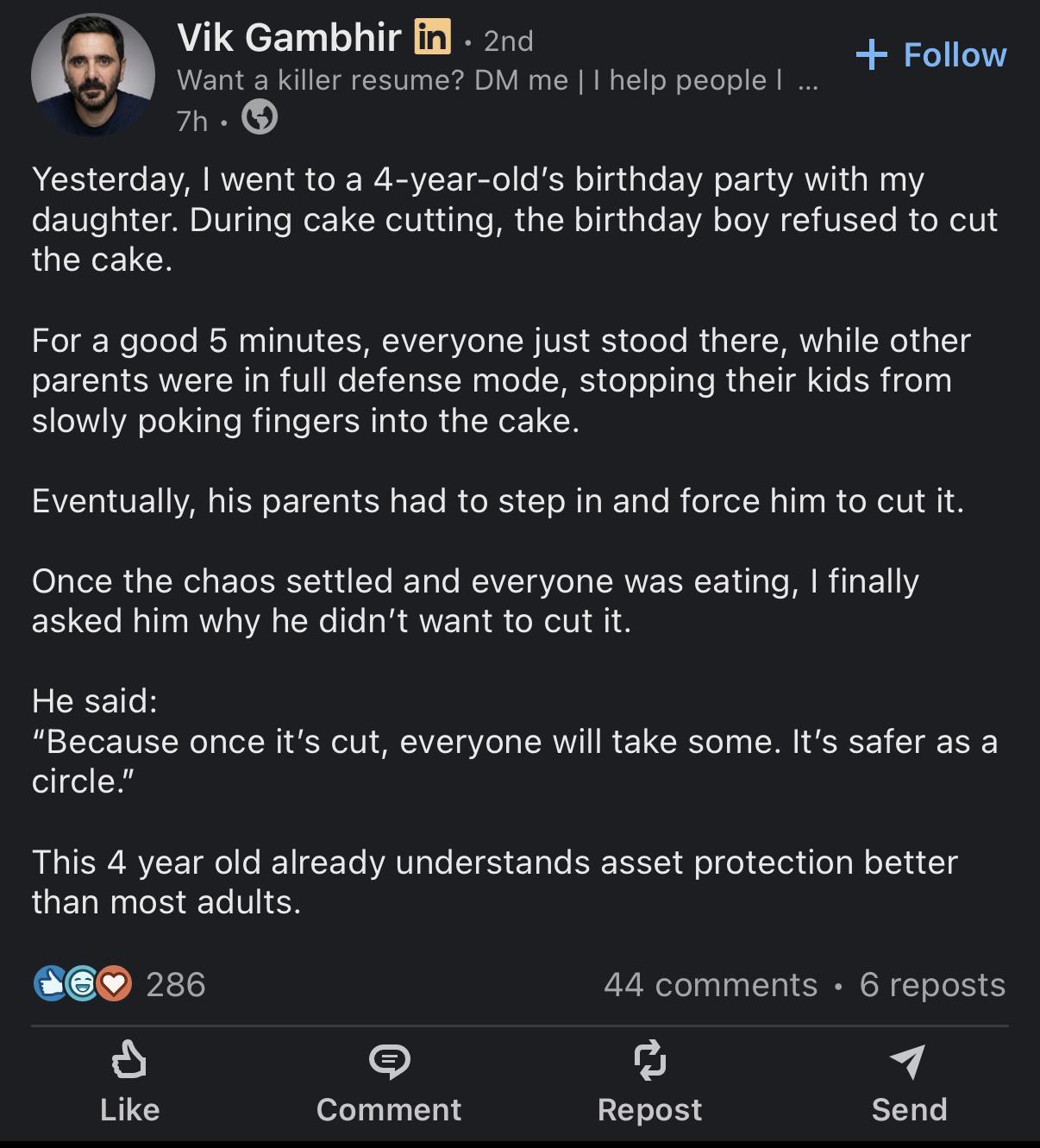
THE specimen, recovered from LinkedIn by way of the Reddit forum r/LinkedInLunatics, is a post by one Vik Gambhir, who identifies himself as a resume consultant and financial adviser. In it, Mr. Gambhir recounts a domestic scene: his four-year-old daughter, presented with a chocolate birthday cake, declines to have it cut. From this refusal he extracts a lesson in asset protection strategy, which he then offers to his professional network as actionable insight. Two hundred and eighty-six people indicated that they found this instructive. The figure is worth holding in the mind for a moment, the way one holds a temperature reading that is not yet alarming but suggests the thermometer should be checked.
The post follows a structure that will be familiar to anyone who has spent time on LinkedIn's advice ecosystem, which is to say a structure as fixed and predictable as a balance sheet: the domestic anecdote, rendered in short paragraphs with dramatic line breaks; the manufactured dialogue with a small child, whose speech patterns oscillate between plausible toddler syntax and the cadences of a Chartered Financial Analyst; and the pivot, in which the mundane scene is revealed to contain professional wisdom of such depth that the reader is invited to feel they have been, in a sense, mentored. The cake is not a cake. The child is not a child. The birthday party is a seminar.
What distinguishes Mr. Gambhir's offering from the broader genus is the specificity of his claim. He does not suggest merely that children are wise, or that simplicity contains truths that adults have forgotten, or that we might all benefit from approaching our portfolios with the innocence of youth—any of which would represent a conventional, if unremarkable, deployment of the LinkedIn parable form. He suggests, rather, that a pre-kindergartener has independently derived the logic of asset shielding. The child, by refusing to allow the cake to be divided, has intuited that an asset held whole is an asset protected from the claims of others. This is presented not as metaphor but as diagnosis. The four-year-old, in Mr. Gambhir's account, is not merely charming. She is performing a fiduciary function.
One pauses here to note certain practical difficulties with the analogy. A birthday cake that is never cut is not a protected asset. It is a deteriorating one. Buttercream has a shelf life. The child who refuses to slice the cake has not shielded it from creditors; she has, at best, delayed its consumption until such time as it becomes unfit for consumption entirely—a strategy that, in the financial advisory profession, is more commonly associated with hoarding than with prudent asset management. The cake, uncut, will go stale. The frosting will crust. The candle wax, if not removed, will leave small waxy deposits in the icing that no amount of fiduciary reasoning can render palatable. If Mr. Gambhir's daughter has in fact discovered an approach to asset protection, it is one whose logical endpoint is a hardened, inedible disc in the back of a refrigerator—which, come to think of it, may describe certain investment vehicles more accurately than he intended.
But the structural interest of the specimen transcends Mr. Gambhir's specific claims. What is notable is the degree to which the post is indistinguishable from the platform's native output regardless of its origin. The headshot accompanying the post bears minor hallmarks of generation or heavy filtering—a certain smoothness around the jaw, a luminosity in the eyes that owes more to computation than to natural light—but is inconclusive. The text's cadence, with its staccato paragraphs and aphoristic child, is consistent with both the ghostwriting tools that have proliferated across LinkedIn's advisory class and the organic culture those tools were trained on. This is the more durable observation: the platform has achieved a register in which human-composed and machine-generated professional counsel are converging toward the same hollow parable form. The question of whether Mr. Gambhir wrote the post himself, had it produced by an artificial intelligence tool, or employed one of the many LinkedIn optimization services that now occupy the space between the two is, in a meaningful sense, immaterial. The output is the output. The market has spoken, and it speaks in birthday cake metaphors.
The 286 endorsements represent a small but real economy of attention. Each one is a unit of professional credibility extended on the basis of a story about a child who would not share dessert. In aggregate, they constitute a minor but measurable transfer of reputational capital from the endorsers to the endorsed—a transaction conducted on terms that, if presented in a prospectus, would require several pages of risk disclosures. That no such disclosures accompany the post is perhaps the most instructive feature of LinkedIn's advice marketplace: it operates without a regulatory framework because no one has yet determined what, precisely, is being sold. It is not financial advice, which would trigger compliance obligations. It is not entertainment, which would need to be entertaining. It is something else—a professional performance that generates engagement, which generates visibility, which generates, presumably, clients, who will then receive advice derived from sources more rigorous than a four-year-old's relationship to baked goods.
One hopes.