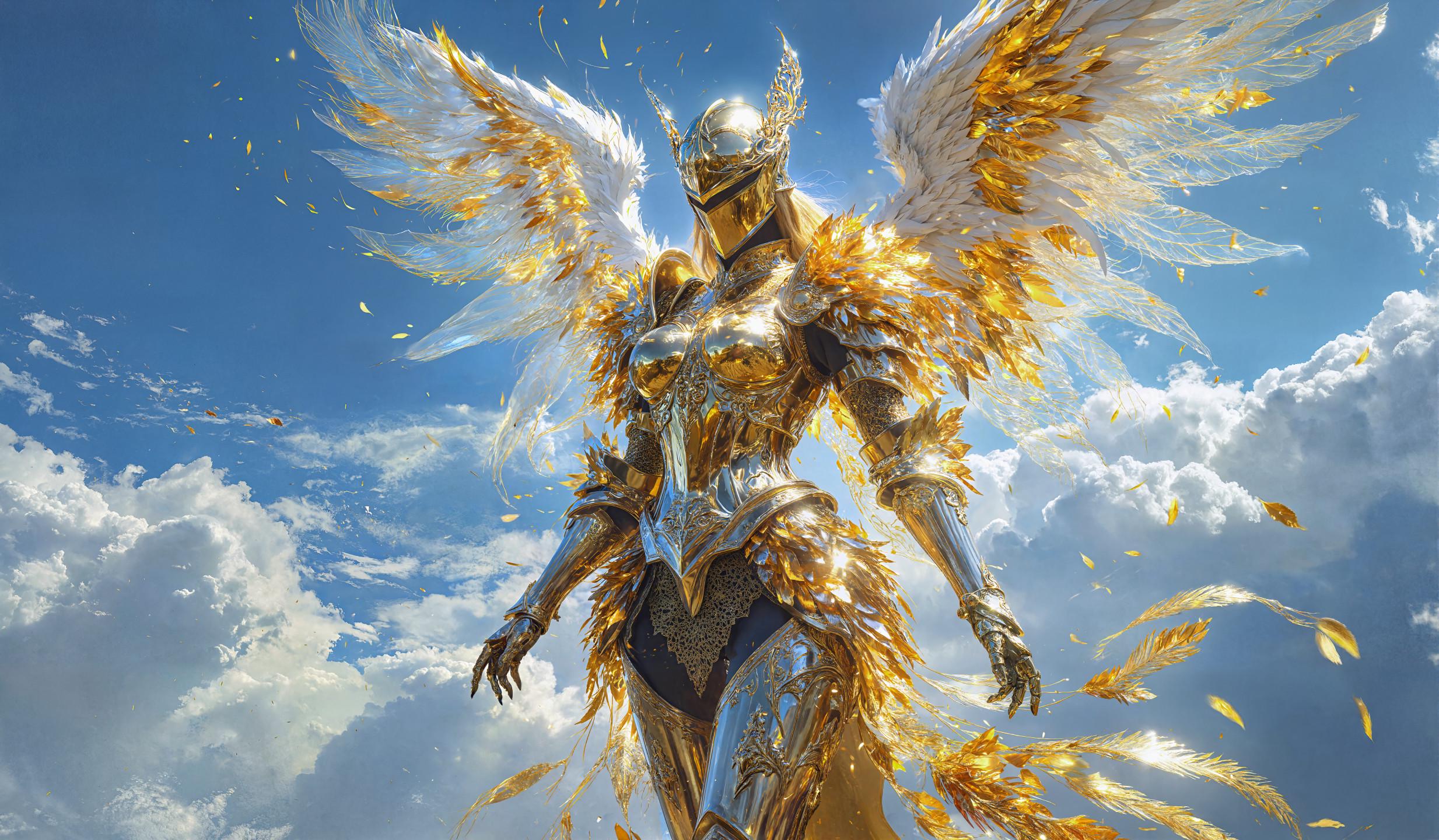
The specimen is an angel. Let us begin there, because the machine certainly did not. What Midjourney has produced and what a user on Reddit's r/AIGeneratedArt has titled "The White Verdict" is a winged figure in white—robed, luminous, bearing the posture of adjudication—that possesses every visual signifier of celestial authority and not one structural element that would permit the figure to exist. This is not a failure of imagination but something more instructive: a perfect success at producing the *appearance* of imagination, which turns out to be a different thing.
The wings are the obvious place to look, so let us look. They extend from the figure's back in bilateral symmetry so absolute that the word "symmetry" flatters it. Symmetry implies two things that correspond. What we have here is one thing mirrored—a single pattern reflected across a vertical axis with the fidelity of wallpaper, not anatomy. No living wing has ever grown this way. The barbs do not interlock; they gleam. The coverts do not layer; they repeat. Each feather possesses the uniform luminosity of a surface that has never been subject to wind, gravity, or the inconvenience of growing from a living body. They are feathers in the way that the word "feather" is a feather—referential, not structural.
This matters because the title asks us to take the figure seriously. "The White Verdict." One waits for the verdict. It does not arrive, because it was never composed—only named. The title enacts the same gesture as the image: it deploys the vocabulary of gravity without performing the labor that gravity requires. A verdict demands a case, a deliberation, a body of evidence weighed. The word "white" modifies nothing; it describes everything visible and specifies nothing meant. The machine that produced this angel also produced this title's logic. Or rather: the same impulse that selects "verdict" from the available lexicon of seriousness is the impulse that selects "angel" from the available lexicon of awe. Neither selection required understanding what the word does. Both required only knowing where the word sits.
I want to be precise about what the figure itself achieves. The face—if we can locate it beneath the hood's soft geometry—is composed with Midjourney's characteristic facility for the numinous: slightly androgynous, slightly sorrowful, entirely without specificity. It is a face that has been averaged from ten thousand painted saints and carries, therefore, the emotional register of none of them. Giotto's angels are clumsy and alive. Caravaggio's are rent boys with prop wings who look like they have opinions about dinner. This angel has been extruded from the statistical mean of all angels and arrives at the viewer with the affect of a hotel lobby. It refers to transcendence the way a spa refers to nature.
The theological pretension deserves examination not as blasphemy—the image is far too polished to blaspheme—but as a case study in what generators produce when asked to render judgment. The machine has delivered an angel that could not fly, pronouncing a verdict it cannot read, in a composition that understands "sacred" as a lighting condition. And here is where the specimen becomes instructive: Midjourney does not fail at the sacred because it lacks reverence. It fails because it has identified, with considerable statistical accuracy, what reverence *looks like*—the white robes, the radiant periphery, the downcast eyes, the wings—and has reconstructed these elements without access to what they are *for*. The result is iconography without icon. The apparatus of the courtroom, empty.
What the artist—the user who typed the prompt and selected from the outputs—has done is endorse this emptiness as sufficient. The choice to post, to title, to present the image as "The White Verdict" rather than "an interesting thing the machine made" is the genuinely creative act here, and it is an act of misrecognition. The user has seen the solemnity the machine produced and mistaken it for the solemnity the machine intended. But the machine intended nothing. Intention is not a feature it offers. What it offers is pattern-completion at scale, and the pattern it has completed is: things that look important look like this.
The specimen is, finally, a useful object. Not as art—it makes no decisions, conscious or otherwise—but as evidence. It documents, with inadvertent clarity, the difference between depicting authority and possessing it. The angel stands. The verdict goes unread. The wings, which have never known weather, gleam on.
Specimen: Digital image depicting a winged figure in white robes, posed in attitude of celestial judgment. Recovered from Reddit, r/AIGeneratedArt, user-posted with title "The White Verdict," 2024. Bilateral wing symmetry consistent with pattern-mirroring rather than anatomical reference.