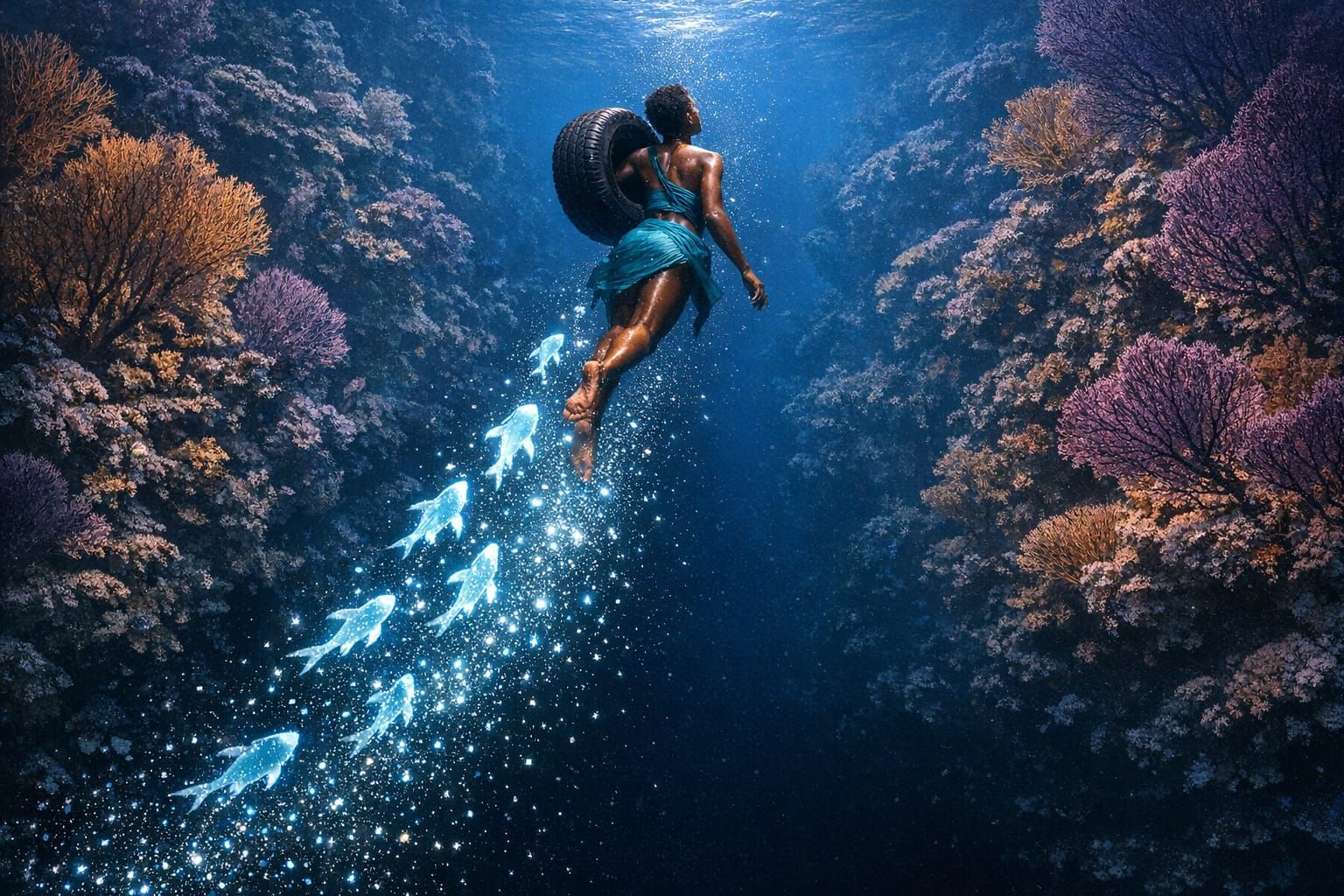
T he question is not whether the machine can make a picture of the ocean. The question is whether the machine knows what it has made. "The Ocean's Exhale"—posted to the forum r/AIGeneratedArt, attributed to Midjourney, bearing the serene confidence of a thing that has never been to the ocean—answers this question with a completeness that borders on philosophical demonstration.
Begin with the title, because the operator did. "The Ocean's Exhale." It is a metaphor, and not a bad one. The sea does something like breathing—the tidal rhythm, the shorebreak's release, the long withdrawal of water over sand that resembles nothing so much as a body letting go. Poets have noted this. Painters have worked with it. The metaphor is old enough to have earned its keep. The operator, selecting it, made the single creative decision available in the process: the prompt. Everything that followed was delegation.
What the system delivered, in response to a request organized around breath, is a figure whose anatomy cannot support the act. The torso presents errors not of style but of structure. The relationship between rib cage and shoulder is not abstracted, not stylized, not chosen—it is absent, in the specific way that absence registers when a system has consumed ten million photographs of the human body and learned the statistical average of all of them without apprehending the skeleton beneath any single one. The lungs implied by this figure's thoracic cavity could not inflate. The diaphragm has no plausible anchor. The operator asked for exhalation, and the machine produced a figure for whom inhalation was never available.
The irony is not constructed. No satirist arranged it. It is emergent—the natural consequence of a system that processes language and image on parallel tracks that never merge into comprehension. The machine can title. It cannot inhabit. It receives the word "exhale" and produces visual matter adjacent to breath without understanding that breath requires specific, non-negotiable physical architecture. This is the gap, and it is the only gap that matters in the current moment: the distance between adjacency and understanding, between correlation and meaning.
But the specimen rewards further attention, because the failures are not random. They are structurally symmetric—which is itself the second failure, and the more revealing one.
The ocean is never symmetric. This is among its most fundamental visual properties. Every wave is a singularity. The foam patterns left on sand are as unrepeatable as fingerprints. The light on moving water shifts by the millisecond. A painter working from observation, or even from memory, knows this in the hand before the mind has named it. The Midjourney production renders the sea in bilateral symmetry—the left half of the composition mirroring the right with the eerie precision of a Rorschach plate. The water has been made into a decorative pattern. The ocean, which is chaos organized by physics, has been replaced by order organized by statistics.
And here the inversion completes itself. The human body—which does rely on bilateral symmetry, which is in fact organized around a vertical axis of approximate mirror correspondence—has had its symmetry broken. The shoulders do not match. The proportions shift across the midline. The figure, which should be symmetric, is not. The ocean, which should not be, is. The machine has performed a perfect exchange, giving to each subject the other's defining characteristic, and it has done so without intent, without irony, without awareness. The result is a composition whose internal logic is exactly reversed, and which is therefore, in the strictest sense, a more complete artistic statement than the operator intended—though the statement it makes is about the machine, not the sea.
This is what distinguishes the present moment in machine-generated visual production from any prior technological disruption in the arts. The camera, that earlier crisis, recorded what was in front of it. The operator's eye determined the frame, but the light did honest work. Here, nothing is recorded. Everything is generated. And generation without comprehension produces artefacts that are—the word must be used precisely—uncanny. Not in the colloquial sense. In Freud's sense. The familiar made unfamiliar. The human form, rendered by a system trained on millions of human forms, returned to us as something that resembles a body the way a department-store mannequin resembles a body: all the surfaces present, the underlying structure a fiction.
The operator titled their work "The Ocean's Exhale" and the system, in its diligent and empty way, produced a figure that will never breathe at the edge of an ocean that will never move. The metaphor was sound. The execution is its own rebuttal.