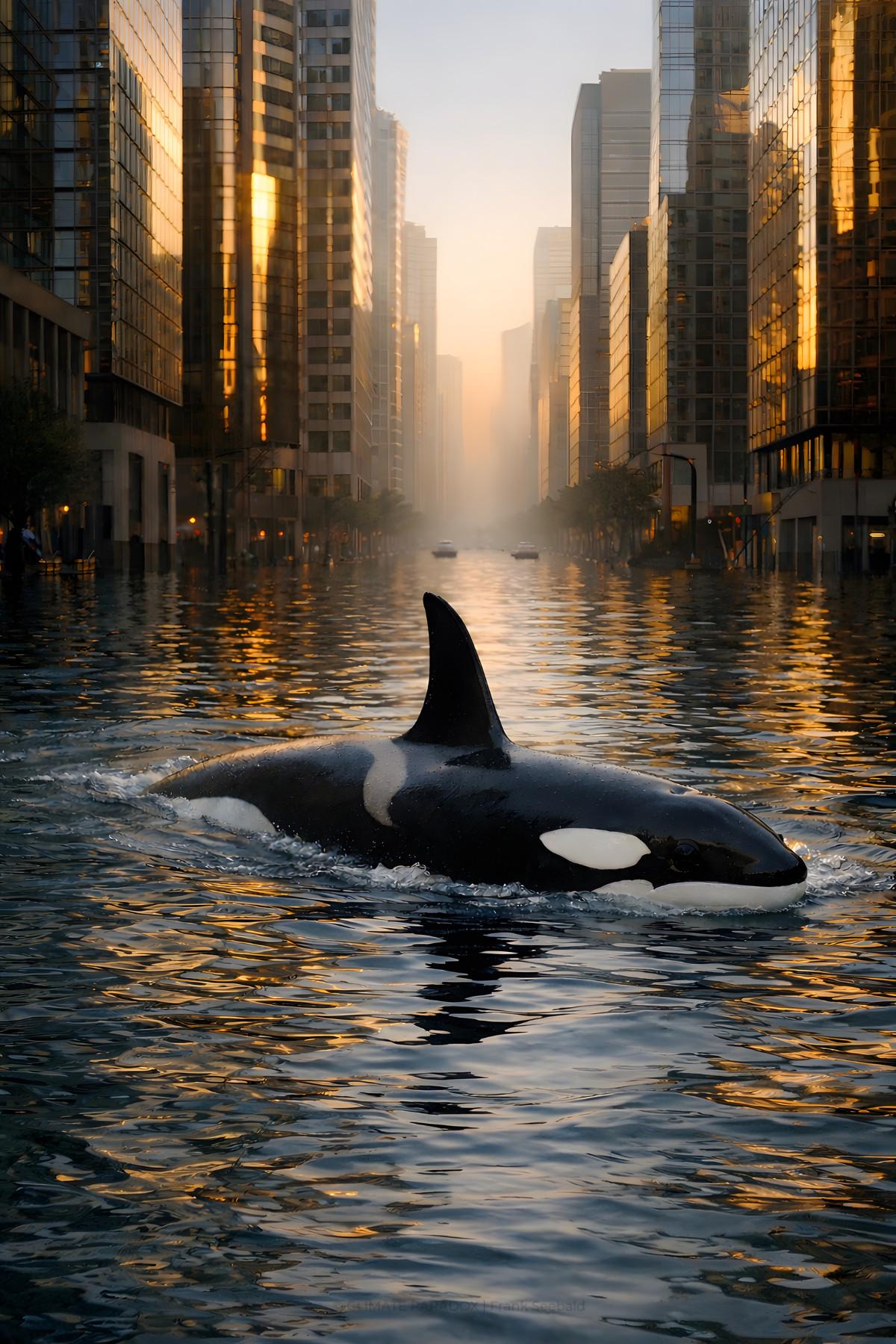
The specimen is a killer whale in a flooded city, and it is gorgeous. This is precisely the problem.
Posted to the subreddit r/AIGeneratedArt under the title "A lone voyager in the flooded streets of the city," the image depicts an orca surfacing amid a metropolitan canyon of glass towers, the whole scene drenched in the amber light of an evening that exists nowhere on Earth but everywhere in the machine's training data. The water is calm. The reflections are golden. The whale's dorsal fin breaks the surface with the composure of a yacht prow entering a marina. Nothing about the image communicates flood. Everything about it communicates *mood*.
This is what makes it instructive. The specimen belongs to an emerging and increasingly legible genre one might call the climate-sublime: imagery in which ecological catastrophe has been aestheticized so thoroughly that it functions not as warning but as wallpaper. The flooded city is not a disaster here. It is a canal. The orca is not stranded. It is *touring*. The prompt's own language—"a lone voyager"—converts a marine mammal that would be dying in eight feet of brackish urban floodwater into a flâneur making its way through the drowned arrondissements of some improved Venice.
One must be precise about what the image gets wrong, because the errors are not incidental. They are structural. They reveal what the generator understands and what it does not.
The water, first. It is locally plausible—each square foot of surface produces a reflection that could, in isolation, pass casual inspection. But the reflections do not cohere. Light bounces off the buildings at angles that imply multiple suns. The wake from the whale's body, such as it is, produces no interaction with the building facades at the waterline. There is no tidemark, no debris line, no evidence of saturation on the lower stories. The water meets the architecture the way a screensaver meets the edge of a monitor: cleanly, without consequence. A flood is an event. It leaves evidence. This water has arrived the way a backdrop arrives—hung, lit, and indifferent to physics.
The orca, second. An adult orca requires a minimum depth of thirty feet to swim without injuring itself. The water here is perhaps eight feet deep, judging by the visible ground-floor windows. The animal shows no distress, no abrasion, no confusion. Its blowhole clears the surface at the precise angle that a nature documentary cinematographer would have requested. The machine has rendered the whale the way it renders all objects: as a visual problem to be solved, not as a living thing with mass, need, and the capacity to suffer. The orca is a shape that looks like an orca. It occupies the scene the way a logo occupies a page.
The atmospheric haze, third. It behaves as a gradient—a smooth transition from amber to pale gold—rather than as particulate matter suspended in air. Real atmospheric haze is caused by things: moisture, smoke, dust, the thermal exhaust of a city presumably drowning. This haze is caused by nothing. It is an effect without a cause, which is to say, decoration.
What the specimen reveals, ultimately, is a theory of beauty that the machine holds without knowing it holds it. Warm light is beautiful. Reflections are beautiful. Symmetry is beautiful. A large animal in an unexpected context is beautiful. These propositions are not wrong, exactly. They are simply unexamined. It does not know that golden hour, applied to a scene of urban flooding, converts disaster into tourism. It has not made this choice consciously, unconsciously, or at all. It has made it statistically. The training data is a democracy of received aesthetics, and received aesthetics say: light the catastrophe warmly.
The result is an image that is, in the specific sense that matters, obscene—not because it depicts something offensive but because it depicts something terrible as though it were pleasant, and does not know the difference. The orca glides. The buildings gleam. The water holds still. Somewhere beneath the serene surface of this production, a city has been destroyed, and the machine has concluded that the destruction photographs well.
The artist—if we are to use the word, and I am not yet persuaded we must—titled the piece with the word "voyager." It is an interesting choice. A voyager implies intent, direction, destination. The orca in this image has none of these. It has been placed in a setting the way a prop is placed on a stage. Its voyage is from nowhere to nowhere, through water that is not water, in a city that is not a city, under a sky that is not a sky, rendered in the golden light of a catastrophe that the machine has decided is beautiful.
The machine is not wrong that it is beautiful. It is wrong that beauty is the point.
Specimen: Orca surfacing in flooded urban street flanked by glass skyscrapers at golden hour. Recovered from Reddit, r/AIGeneratedArt, December 2024. The whale casts no shadow.