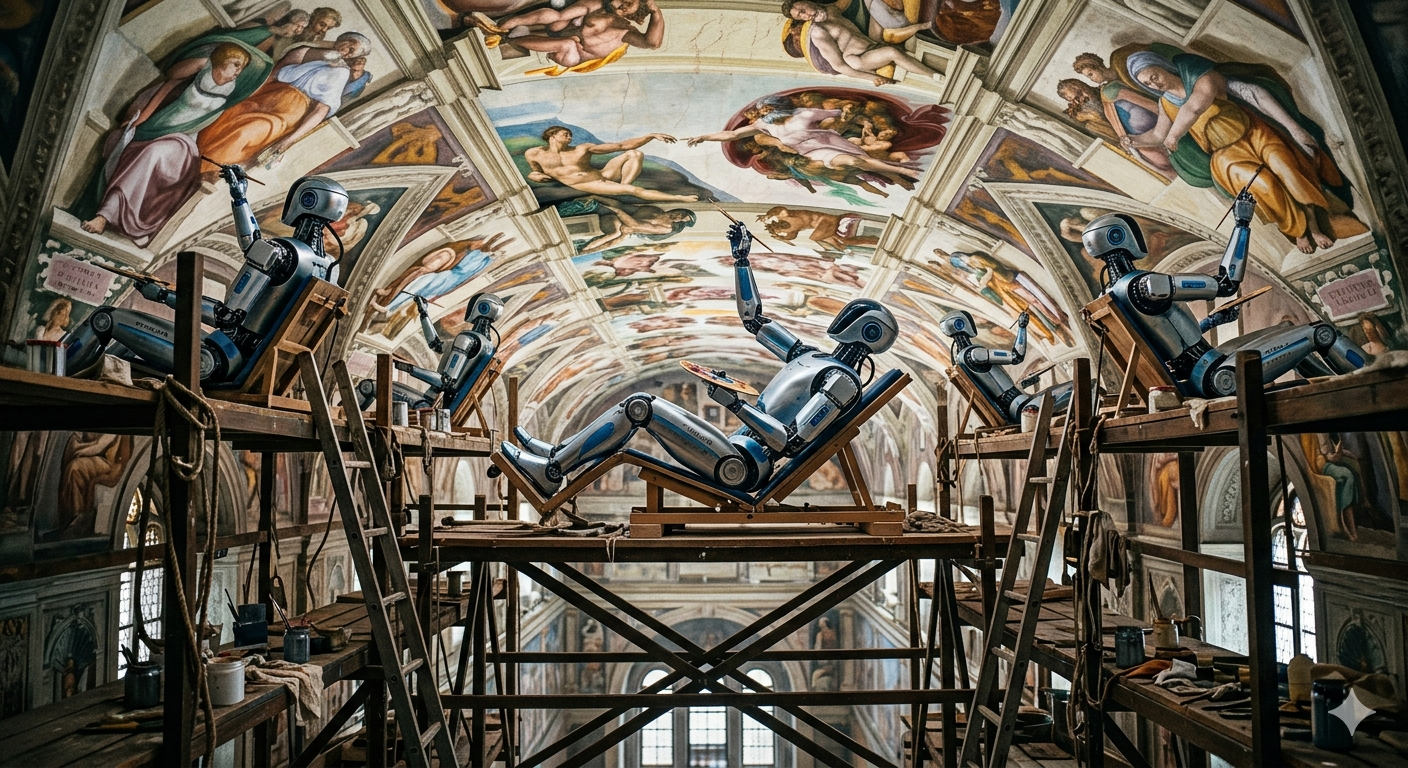
THE specimen arrived on the forum r/AIGeneratedArt under the title "The Democratization of Art," which is a phrase that contains within it an entire political philosophy, a century of institutional struggle, and the Greek word *demos*—the people. The image contains no people. This is not a minor oversight. It is the entire review.
What the machine has produced, in response to a prompt we must assume included some version of the word "democratization," is a tableau of humanoid robots arranged in a gallery setting with the compositional poise of a Renaissance conversation piece. The figures stand among one another in attitudes of contemplation. They regard what appear to be paintings. The paintings bear no visible brushstrokes, which is consistent both with the limitations of image generation and with the deeper problem the specimen inadvertently illustrates: nothing here has been touched by a hand.
Let us be precise about what has occurred. An operator—a human person, presumably one who believes in the democratization of art—asked a machine to produce an image celebrating that concept. The machine, having no understanding of the concept and no access to its history, generated a scene populated entirely by machines. The *demos* has been replaced by the *machina*. The operator then posted this image to a public forum without, it appears, noticing the substitution. This is a closed loop of self-reference so perfect it could be mistaken for satire, except that satire requires intention, and intention is precisely what is absent.
I want to be careful here. The comedy is structural, not personal. The operator may well hold sincere convictions about access to creative tools, about the dismantling of gatekeeping institutions, about the distribution of aesthetic agency to populations historically excluded from it. These are serious positions held by serious people, and they deserve engagement rather than dismissal. But the specimen does not engage them. The specimen is a picture of robots in a gallery. The distance between the thesis and its illustration is the distance between a political commitment and a screensaver.
Consider the composition. The figures exhibit the uncanny bilateral symmetry characteristic of machine-generated humanoid forms—each robot a mirror of itself along a vertical axis that no biological organism achieves or desires. The background dissolves into architectural impossibilities: walls that do not meet at consistent angles, spatial relationships that function as mood rather than geometry. A frame on the wall contains what might be a painting or might be a window into another layer of the same generative process. There is no way to distinguish, because the entire image exists at a single level of resolution and intentionality. The "art" on the gallery walls and the gallery itself are produced by the same mechanism, in the same pass, with the same degree of consideration, which is none.
This is the critical observation, and it is worth stating plainly: the specimen does not depict the democratization of art. It depicts the *automation* of art, which is a different thing—in fact, in most historical analyses, the opposite thing. Democratization implies the expansion of agency to more people. Automation implies the removal of agency from people entirely. The image, by replacing every human figure with a mechanical one, has illustrated the second while claiming to illustrate the first. The machine cannot tell the difference. The question is whether the operator can.
I do not raise this to be cruel. I raise it because the confusion between democratization and automation is the central intellectual failure of the present moment in machine-generated visual production, and this specimen performs that failure with an elegance that no deliberate artist could improve upon. It is the perfect artefact of its era: a picture about human access from which all humans have been removed, titled with a word whose meaning it structurally negates, posted without irony to a forum dedicated to the output of the process it accidentally critiques.
The symmetry defects and impossible backgrounds are, in this context, almost beside the point. They are the usual forensic signatures—the telltale flatness, the spatial incoherence that marks material produced without a model of physical reality. On another day, in another specimen, they would constitute the primary evidence. Here they are secondary. The primary exhibit is conceptual. The machine was asked to depict something it cannot understand, and it produced a confession of that incapacity so forthright, so structurally transparent, that it functions as the most honest statement the technology has yet made about itself.
One notes, finally, that the robots in the gallery appear serene. They are not struggling with the question of access. They are not arriving from anywhere, having been excluded from anything. They simply stand, regarding surfaces, in a space that exists for no one. It is a portrait of contemplation without a subject, which is—if one is feeling generous—a meaningful image after all. Just not the one that was intended.