DECK: *A Reddit submission attributes a static image to Suno, an audio generator, and the layered category error becomes the work's only honest gesture.*
BYLINE: By Lydia Channing / Arts & Culture Editor, Slopgate
The specimen arrives on the subreddit r/AIGeneratedArt under the title "Made with Suno." Suno generates music. The specimen is an image. This is the first fact, and one is tempted to stop there, because the rest of the article is contained in it.
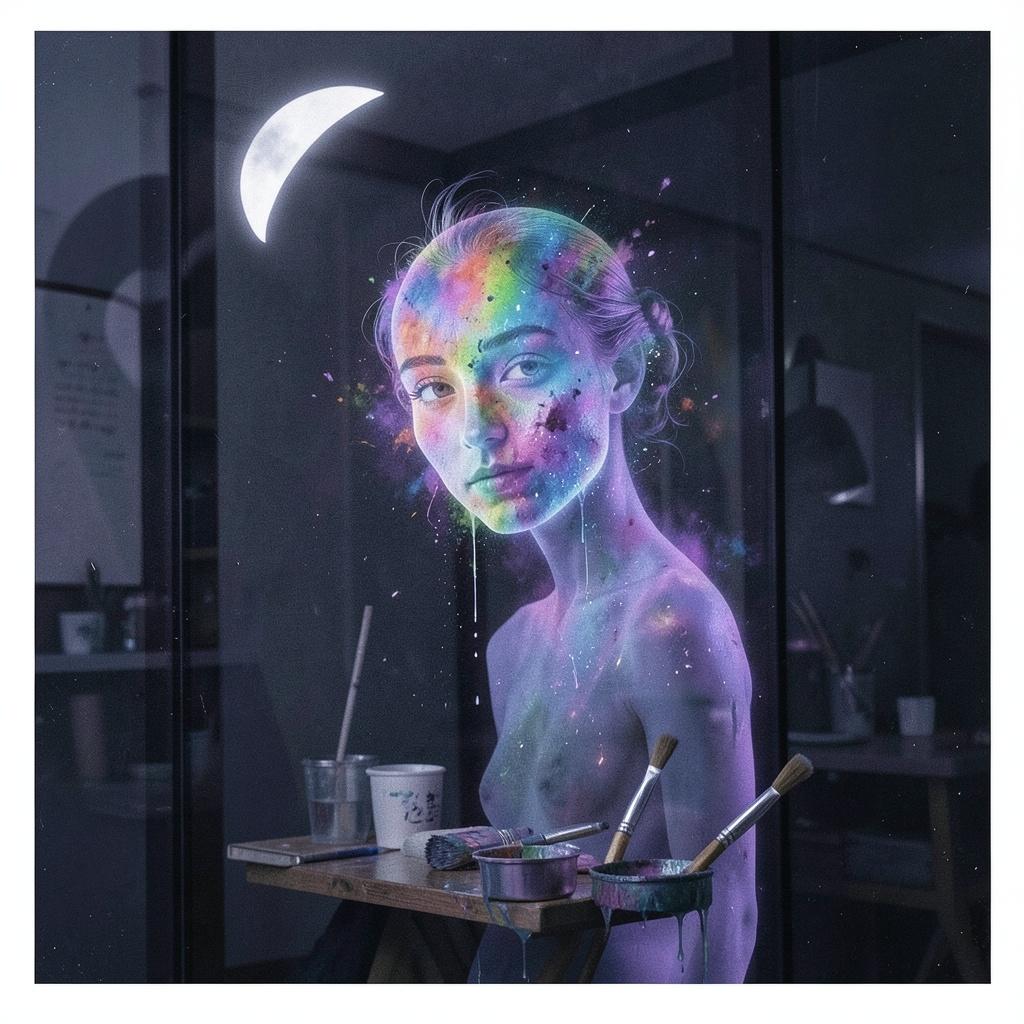
The image depicts a human figure at an easel, surrounded by paintbrushes. The brushes do not rest in a jar, on a table, in a hand. They float. Three of them occupy positions that no brush has ever occupied, held by no fingers, suspended at angles that suggest the prompt requested "many brushes" and the model obliged without committing to gravity. The figure's skin has the quality one has learned to recognize: too smooth in some passages, too granular in others, as though two different surfaces were negotiated in committee. The eyes are nearly symmetrical. The hands, mercifully, are mostly out of frame.
To assess any object in this column I apply a single test. Has the maker made decisions consciously, unconsciously, or not at all? The auteur framework presumes a maker. Here the question must be asked twice, once of the image and once of the caption, and the answers do not match.
The image was made by a model whose decisions are statistical and therefore neither conscious nor unconscious in any sense the framework can use. It produced a painter because painters are well represented in its training data; it produced floating brushes because brushes are well represented and gravity is not a feature the model was asked to honor. The skin texture is the residue of averaging. None of this is interesting. We have been writing this paragraph for three years.
What is interesting is the caption. "Made with Suno" is either an error or a shrug. If it is an error, the submitter believed Suno produces images and was mistaken about the tool they used; the misattribution then suggests that the tools have become interchangeable in the user's mind, which is to say the user does not distinguish between the production of sound and the production of sight. If it is a shrug, "Suno" is being used as a generic—the way an earlier generation said "Kleenex" or "Xerox"—and the user is indifferent to which machine produced the artefact because the question of which machine is no longer felt to matter. Both readings describe the same condition. The condition is that the apparatus has dissolved into a single undifferentiated faculty called *making*, and the maker can no longer name what they used because what they used has no name they need.
This would be merely sociological if the image's subject were anything else. It is not. The subject is a painter. The image depicts, with the inattention characteristic of the form, a human being engaged in the slow physical labor of moving pigment across a surface with a tool held in the hand. The model has rendered the iconography of manual craft—the easel, the brushes, the posture—and the submitter has credited a music platform for the rendering. A music tool is named as the author of an image of a human making an image by hand. Three categories collapse into one another in a single post, and the collapse is not noted by the submitter, the platform, or, until now, anyone.
The floating brushes are the tell, but not in the way the forensic note suggests. They are the tell because they describe the relation of the apparatus to the craft it depicts. The brushes float because the model has no idea what a brush is for. It knows only what a brush looks like next to a painter. The submitter, crediting Suno, demonstrates the same knowledge in the same register: aware of the iconography of production, unconcerned with its mechanism. The image and the caption are doing the same thing. This is what gives the specimen its compactness. It is internally consistent.
I will note, because the column requires it, that there is no painter. There is no Suno here, in the sense of audio. There is no painting, in the sense of paint. There is an image of a painter, made by a system that was not Suno, posted by a person who said it was, on a forum dedicated to the practice. The only material in the room is the screen.