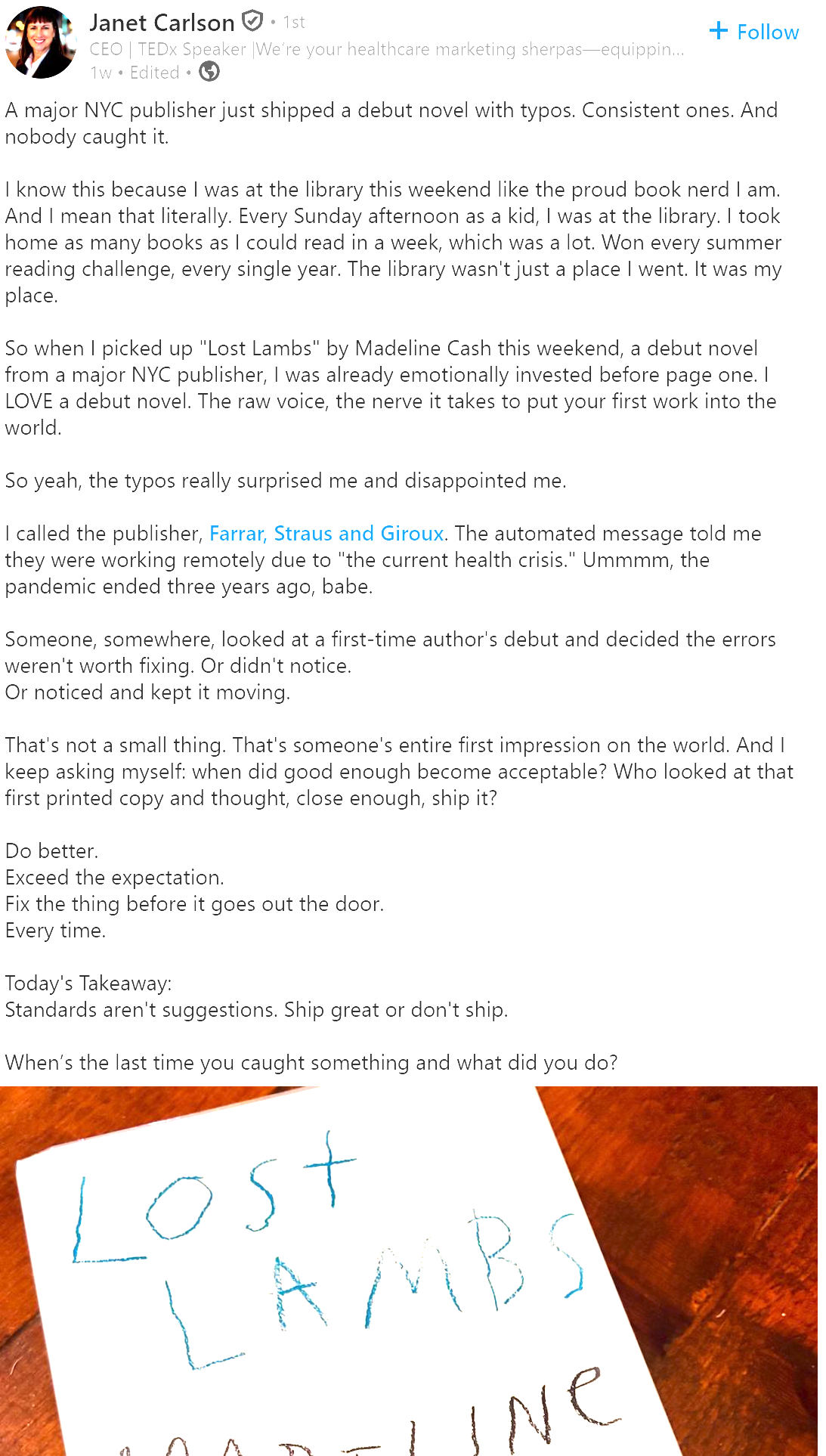
DECK: *The specimen cannot distinguish between a rule broken and a rule mastered.*
BYLINE: By Julian St. John Thorne / Literary Editor, Slopgate
**T**hat a man should presume, in public, to correct a novelist's grammar without first ascertaining whether the offending construction is the result of negligence or of art is a vulgarity old enough to require no further commentary; that the man in question should be neither man nor, in any meaningful sense, present, but rather a stable-diffusion approximation of a face, accompanied by the credential "TEDx Speaker"—italicised, one assumes, by some functionary of the algorithm itself—is the matter to which we must today attend.
The specimen arrived through ordinary channels: a screenshot deposited upon Reddit, in the bestiary maintained for such purposes, where it was held up not for analysis but for the pleasure of common derision. We make no such pleasure our business. We attend to the specimen because it is, in its small way, instructive.
Permit me to describe what is shown. A portrait—in the loose sense of that word—occupies the upper portion of the post: a man, or the suggestion of a man, of the sort the diffusion models have begun to produce in such quantity that one feels, looking at them, the slight vertigo one feels upon entering a wax museum after a long walk. The texture is uniform where texture ought to vary; the symmetry is the symmetry of a thing that has not lived. Behind him, what one may charitably call a bookshelf bears the customary lettering—Latinate gibberish, the spines confused as to which direction is up, the titles dissolving into the illegible run-on that is the model's confession of its own illiteracy. The caption, set in corporate sans-serif, charges the publisher with having permitted certain solecisms to enter the printed text of a debut novelist's first book.
The novelist, as anyone with the patience to read the book in question would know, intended the solecisms. They are deliberate. They are, in the technical sense, craft.
This is the recursion that gives the specimen its particular beauty, and it deserves to be set down plainly: a production incapable of rendering, on its own surface, the words BOOK or AUTHOR without dissolving into an Aramaic of misplaced ligatures has been deployed to chastise a human writer for offences against the English language which the human writer did not in fact commit. The artefact criticises a craft it cannot achieve, on grounds it does not understand, in the name of a standard it itself fails by every available measure.
One does not wish to be unkind to the gentleman whose name appears beneath the portrait. He may exist. The TEDx credential, whilst no guarantor of literary judgment, is no certain disqualification from it either; men have surprised us before. But the credential is load-bearing in this transaction, and it ought to be examined. "TEDx Speaker," in the LinkedIn register, performs the function once performed by the considerably more demanding designation "scholar": it certifies that one has spoken, before an audience, on a topic, for a duration, with apparent confidence. It does not, and is not designed to, certify that one has read the book.
Here is the thing that is genuinely new, and worth saying. The prior dispensation, in which the unread upbraided the read, required at least a face. The man with the wrong opinion about a novel he had not opened was, at minimum, present; one could imagine him; one could, with a little effort, pity him. The new dispensation supplies the face. It supplies the bookshelf. It supplies, by way of the diffusion model's mute industry, even the suggestion of authority—the spectacles, the half-smile, the carefully unbuttoned collar. What it does not supply, what it has not yet learned to counterfeit, is the reading. The reading remains, for now, a human burden, and a willing one.
The novelist, as of this filing, has not responded. We have written. We expect, given the publishing schedule and the novelist's own sense of proportion, no reply, and we should think less of him if we received one. The specimen is not addressed to him. The specimen is addressed to the algorithm that ranks the post, and to the readers who, having spent some seconds upon the portrait, will move on, persuaded that someone, somewhere, has been corrected.
CUTLINE: Specimen: a machine-generated portrait of a purported chief executive, accompanied by a caption censuring a publisher for permitting grammatical errors in a debut novel. Recovered from LinkedIn, account self-designated "CEO & TEDx Speaker," via r/LinkedInLunatics, November 2025. The volumes shown upon the figure's bookshelf bear titles legible only to the model that produced them.