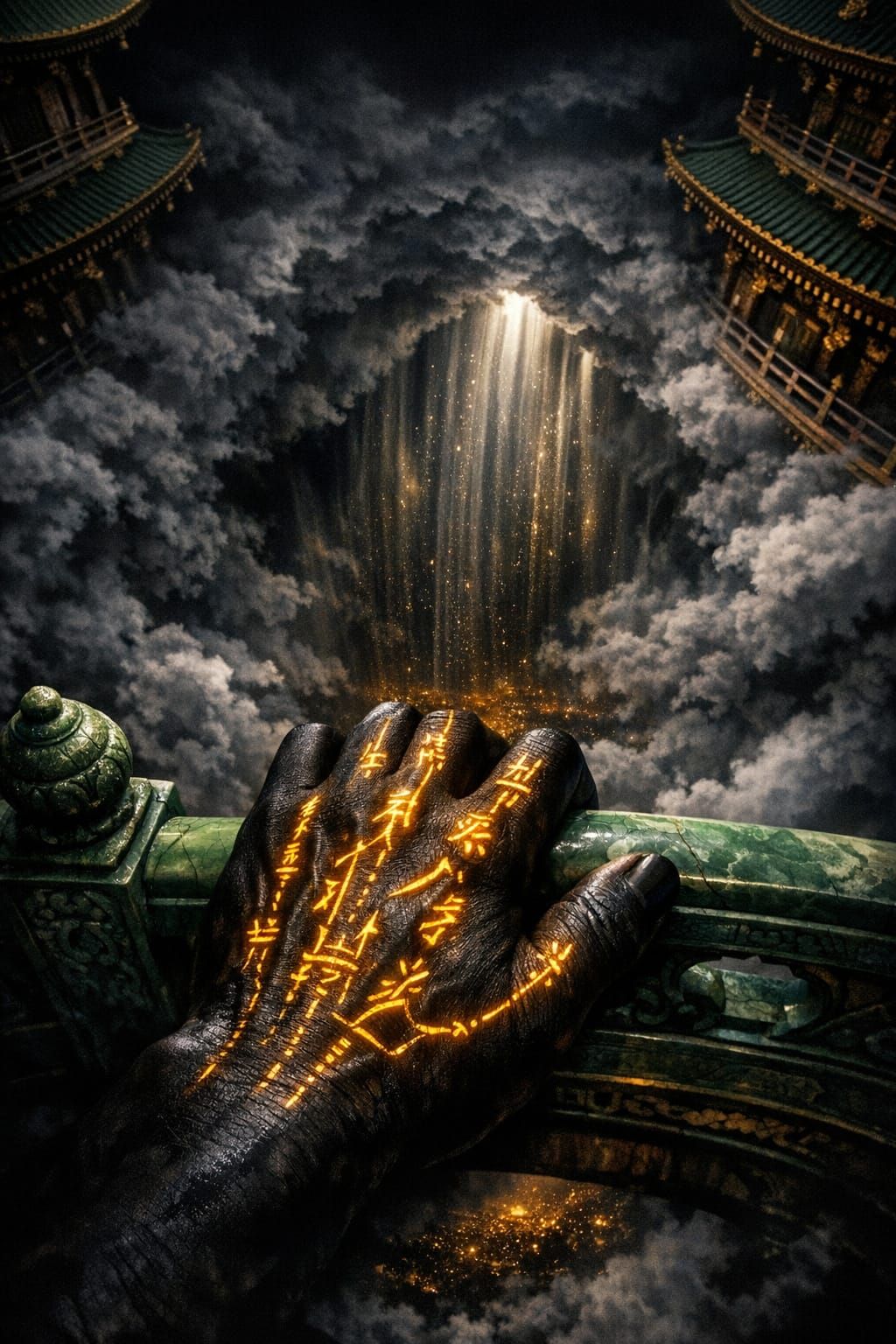
DECK: *Midjourney renders the celestial aperture with atmospheric competence and miscounts the custodian's hand.*
BYLINE: By Lydia Channing / Arts & Culture Editor, Slopgate
[T]he specimen arrives under the title THE HEAVEN'S EYE APERTURE, in capitals, as such things do. It was submitted to the Reddit subforum r/AIGeneratedArt—a community whose name efficiently announces both the medium and the inadequacy of its critical apparatus—and forensic examination attributes production to Midjourney. The image depicts a circular opening in a luminous sky, held parted by a single human hand. The hand has six fingers.
One must begin with the count, because the count is what the image cannot survive. Six fingers on the hand of God—or of the supplicant, since the iconography is unwilling to commit—is not without precedent. Anne Boleyn was said to have one. Certain Byzantine angels were granted one. The Dürer specimen we examined last quarter contains an etching in which a sixth digit appears deliberately, as a marker of the supernatural. There, the finger signifies. Here, it tabulates. The difference between symbol and error is the difference between a decision and a default, and the machine has not decided; it has merely failed to stop.
This is the auteur question in its purest available form. Has the specimen made its decisions consciously, unconsciously, or not at all? Midjourney occupies the third position with such consistency that one begins to wonder whether the third position is a position at all, or merely the absence of one wearing the costume of the other two. The aperture is rendered with genuine atmospheric competence. The clouds part with a lighting model any human painter would have had to study for years to approximate. The eye at the center—for there is an eye, set within the aperture as in a Masonic frontispiece—is rendered with the glassy specificity the machine is reliably good at. And then the hand. And then six fingers. The system has been trained on an ocean of hands and has produced, from that ocean, the single configuration which announces it has never touched one.
What troubles me is not the error. The error is interesting. What troubles me is the symmetry. The composition is bilaterally balanced to a degree no devotional image in the Western tradition would permit. Sacred imagery, when it works, breaks its own symmetry—Christ's tilted head, the Virgin's offset gaze, the asymmetry of the Annunciation in which the angel arrives from one side and disturbs the geometry of the room. Symmetry in religious art is reserved for the mandala and the icon, both of which earn it through a tradition of meaning the machine has not inherited. The specimen's symmetry is the symmetry of a button. It is centered because centering is the path of least computational resistance. The result is an image too composed to be holy, and too miscounted to be technical, suspended in a middle distance the production cannot itself perceive.
This middle distance is the actual subject of the work, though the work does not know it. The aperture wishes to be sublime. The hand wishes to be the hand of the maker. The eye wishes to be the eye of heaven. None of these wishes has been examined; all have been granted. The machine has confused aspiration with composition, the way a well-meaning amateur confuses sincerity with skill. One does not feel contempt for the result. One feels, instead, the particular sadness of watching a process arrive at a destination it cannot recognize as wrong.
It would be a kindness to call this slop. Slop has the dignity of refusal—it asks nothing of the viewer and claims nothing for itself. The specimen is more ambitious and therefore more exposed. It is reaching. The reach is the embarrassment. A still life of a vase, badly rendered, is a small failure. A reach for the divine, undone at the knuckle, is a category of failure with its own iconographic history; we used to call it hubris, before we had machines to perform it on our behalf.
The poster, whose handle I will not reproduce, has captioned the submission "v cool." I have read this caption several times now, searching for the joke, and I am increasingly persuaded it is sincere. That, finally, is the criticism. The hand has six fingers, and no one has counted.
Specimen: Digitally generated image titled 'THE HEAVEN'S EYE APERTURE,' depicting a celestial aperture parted by a hand bearing six digits arrayed in suspicious bilateral symmetry. Recovered from Reddit, r/AIGeneratedArt, April 2026. The thumb, if it is a thumb, is the only finger one can identify with confidence.