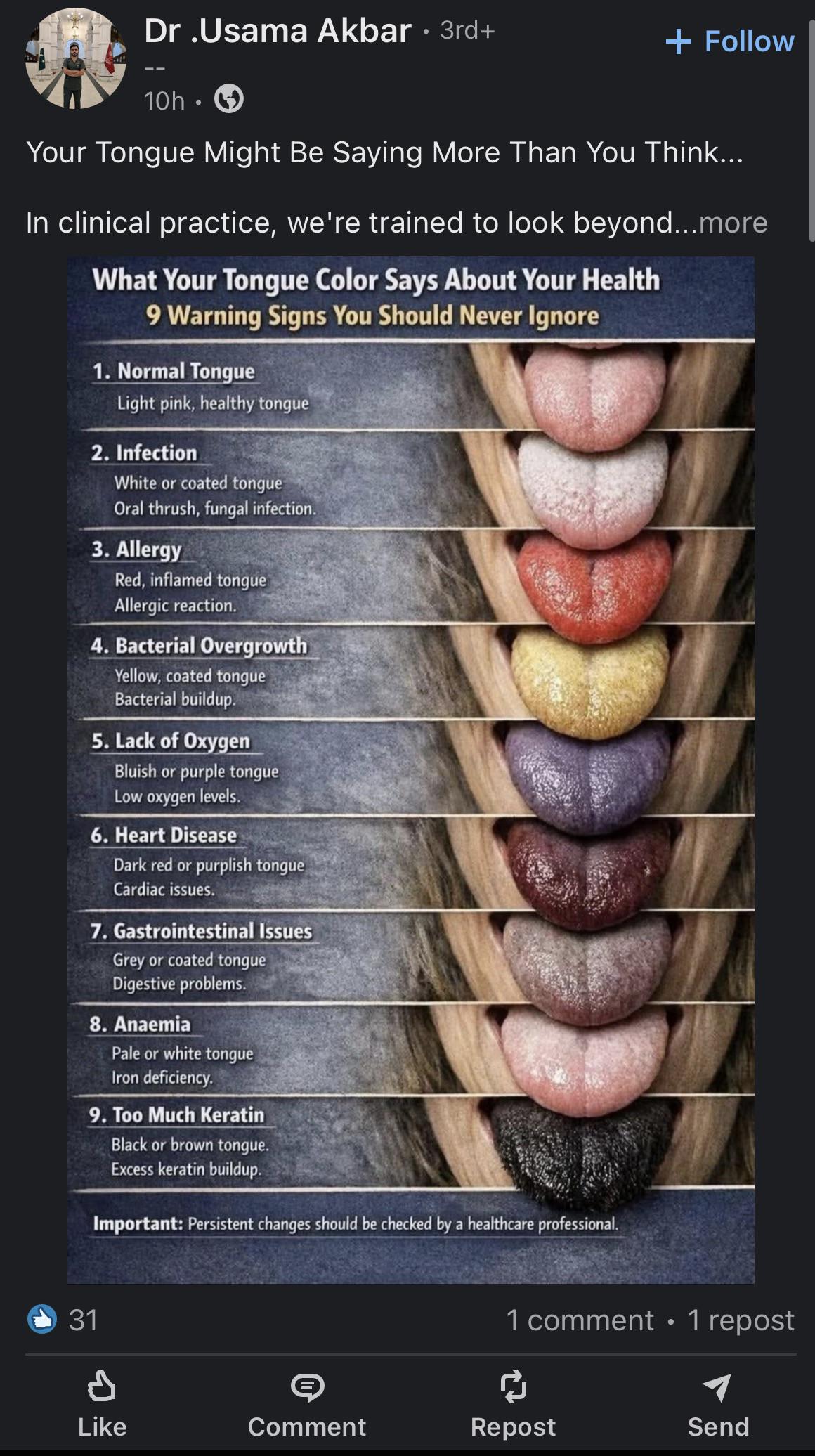
DECK: *Specimen presents the bilateral perfection of an organ no clinician has ever read.*
BYLINE: By Lydia Channing / Arts & Culture Editor, Slopgate
**T**he image arrives with the credentials already attached. A LinkedIn post, a clinician, the apparatus of trained perception. "In clinical practice, we're trained to look beyond the obvious." What follows is a tongue that could not exist.
I want to be exact about this. The tongue is bilaterally symmetrical to a degree no human tongue is. The dorsal surface—the part a clinician actually reads—has been rendered as a single uniform texture, evenly papillated, with the smoothness one finds on plastic anatomical models sold to first-year medical students. The fissures, when they appear, appear in mirrored pairs. The midline groove runs straight as a seam. The organ has been ironed.
This is the auteur question, and the auteur question is the only question worth asking of any artefact. Has the object made its decisions consciously, unconsciously, or not at all? The clinician—let us call him the clinician, since that is the role he has selected for the post—has made one decision, which is to publish. The machine has made every other decision, none of which are decisions. A stable-diffusion model has produced the statistical average of every tongue it has been trained on, and the statistical average of every tongue is a tongue no patient could present with, because real tongues are asymmetric, idiosyncratic, scarred, coated, and mapped by the specific life of the specific mouth.
The specimen's authority depends on a substrate it does not possess. A tongue, in clinical practice, is a surface one reads. Geographic patterns, fissures, coating, and color—these are diagnostic because they are particular. The machine has produced a tongue that is general. It is the tongue one would arrive at if one had heard a tongue described many times and never seen one.
This would be merely interesting were it not for the caption. The caption invokes training: *we are trained to look beyond the obvious*. The post asks the reader to admire the depth of the clinician's perception. The image asks nothing, because it is not capable of asking. What we are looking at is a clinician applying his trained gaze to an artefact that has not been observed by anyone, including the system that produced it. The performance of attention, attached to a thing no one has attended to.
I find I do not have contempt for this. Contempt would be imprecise. The specimen is genuinely interesting in the way certain failures are interesting—it succeeds completely at the performance of clinical authority and fails completely at the substrate of clinical authority, and the gap between these two facts is the entire phenomenon. A doctor I know once told me that the tongue is the most legible organ in the body. The machine has rendered the most legible organ in the body in a way that cannot be read.
There is a side-by-side I would commission if Slopgate's pages permitted: an actual clinical photograph of a normal tongue, laid against this one. The actual tongue would appear, by comparison, somewhat indecent. Asymmetric. Coated. Veined. Marked by a specific morning. The illustration would appear scrubbed, denatured, prepared for inspection by someone who does not inspect. One would understand, looking at the two images, what has been removed in transit from biology to statistics: not detail—the illustration has detail, the illustration is in some sense entirely detail—but the indication that anyone has ever lived inside this mouth.
The post will accumulate engagement. The clinician will receive the deference owed to his white coat. The image will continue to circulate as evidence of perception. None of this will alter what the image is, which is a record of a system that produced an organ without ever encountering one, posted by a man who looked at it and saw confirmation of his training. The slop here—and I use the word with deliberation—is not the image. The slop is the credential applied to the image. The image is merely what it is. The credential is the betrayal.
CUTLINE: Specimen: Machine-generated illustration of a human tongue, captioned with a clinician's invocation of trained perception. Recovered from Reddit, r/LinkedInLunatics, April 2026. Forensic analysis indicates stable-diffusion provenance; the bilateral symmetry is exact to within pixels, and no human tongue achieves it.