DECK: *A hiring manager's LinkedIn dispatch reveals an emerging credentialism in which the ability to detect machine-generated photography is treated as a proxy for intelligence—on a platform where machine-generated thought leadership is the norm.*
BYLINE: By Silas Vane / Business Correspondent, Slopgate
THE practice of screening job applicants by their résumés has long been regarded, within the human-resources profession, as an imperfect but serviceable method of sorting the qualified from the merely ambitious. The practice of screening them by their headshots has a shorter and less distinguished pedigree, confined historically to industries in which physical appearance constitutes a bona fide occupational qualification—modeling, say, or certain categories of hospitality work. It is therefore with some interest that one observes the emergence of a third method, in which an applicant's portrait is examined not for its attractiveness but for its provenance, and in which the determination that the photograph was produced by artificial intelligence rather than a camera is taken as sufficient grounds for disqualification.
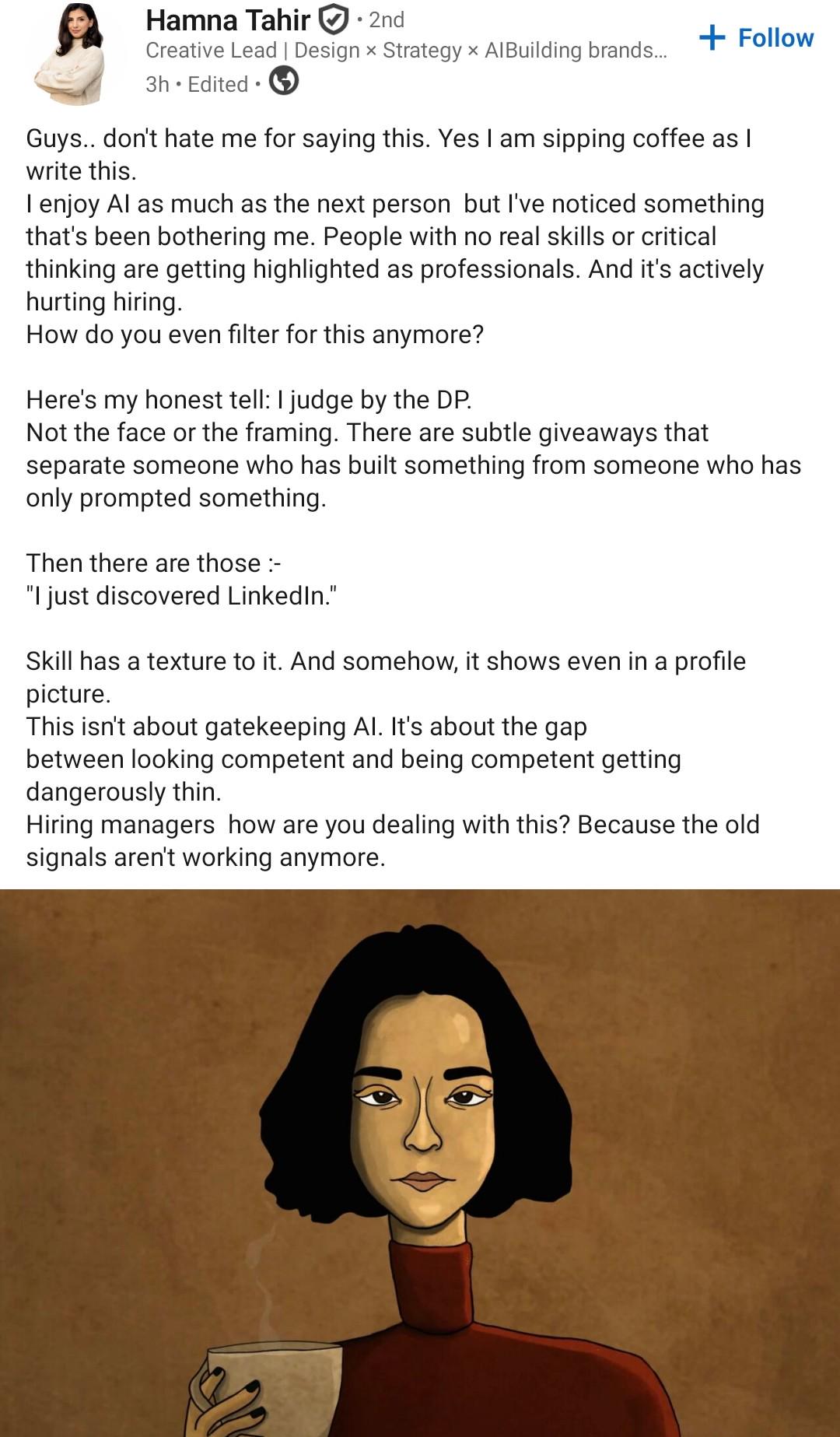
The specimen under review is a LinkedIn post, recovered via the subreddit r/LinkedInLunatics, in which a recruiter or hiring manager announces precisely this practice. The logic, insofar as it can be reconstructed, proceeds as follows: a candidate who submits a machine-generated profile photograph has failed to exercise critical thinking; the failure to exercise critical thinking disqualifies the candidate from roles in which critical thinking is required; therefore, the portrait functions as a litmus test for cognitive capacity. The syllogism is tidy. Its premises are not.
One must note, as a matter of elementary fairness, that the recruiter is not entirely wrong about the portraits themselves. The forensic markers of machine-generated portraiture—the uncanny bilateral symmetry, the smooth texture quality that eliminates pores while preserving an impression of skin, the impossible backgrounds that resolve into nothing when examined at any distance, the text-rendering errors in which letters appear to have been drawn by someone who has seen the Latin alphabet described but never used—these are, at present, reasonably detectable by a trained eye. The specimens produced by systems such as Midjourney occupy a particular valley: too polished to be mistaken for photography by anyone who has ever been photographed, too approximate to be mistaken for art by anyone who has ever looked at any. They are, in effect, a visual press release—a statement of aspiration uncomplicated by the inconvenience of fact.
What is more difficult to credit is the inferential leap from "this person used a generated portrait" to "this person lacks critical thinking." The decision to use such a photograph may reflect any number of things: a lack of a suitable existing headshot, a reluctance to be judged on physical appearance, an insufficient familiarity with the current state of image generation to recognize the output as conspicuous, or—most prosaically—a five-minute decision made during a job-application process that already demands the applicant produce, on average, seventeen distinct documents, three references, and a statement of purpose that no one will read. To locate in this decision the absence of an entire cognitive faculty is to confuse a consumer choice with a philosophical position.
The deeper irony, which the recruiter's post does not appear to contemplate, is one of venue. LinkedIn is, by any available measure, the platform on which machine-generated material has achieved its highest concentration relative to platform prestige. The thought-leadership posts that populate its feed—the parables of entrepreneurial suffering, the lists of seven habits, the anecdotes about firing someone and then hiring them back at twice the salary—have for some time exhibited the hallmarks of automated production: formulaic structure, frictionless sentiment, an absence of any observation that could not have been generated by a system trained on fifteen thousand commencement addresses. The recruiter who announces a capacity to detect artificial portraiture does so within an ecosystem where artificial prose is not merely tolerated but algorithmically rewarded. The gatekeeping, in other words, extends in one direction only.
There is a labor-market question here that deserves more rigorous treatment than this particular specimen affords it. If machine-generated portraiture becomes a disqualifying signal in hiring—a kind of anti-slop credentialism—then the test must be applied with some reliability, and its false-positive rate must be known. At present, neither condition obtains. The recruiter offers no methodology beyond personal inspection, no acknowledgment that real photographs can exhibit symmetry and real people can have smooth skin, and no consideration of the possibility that the reviewer's own detection capacity is neither trained nor tested. It is a screening criterion that has been adopted without validation, applied without consistency, and announced without irony. In this respect it resembles a great many other hiring practices, though few have stated their assumptions quite so plainly.
The economic fact is this: a credential that can be conferred or revoked by a single observer's aesthetic judgment, without appeal, is not a credential at all. It is a preference. Preferences are the prerogative of every hiring manager, and always have been. But the recruiter who mistakes a preference for a methodology—and who broadcasts that mistake on a platform engineered to reward exactly such productions—has, at minimum, constructed a test that the recruiter would not pass.