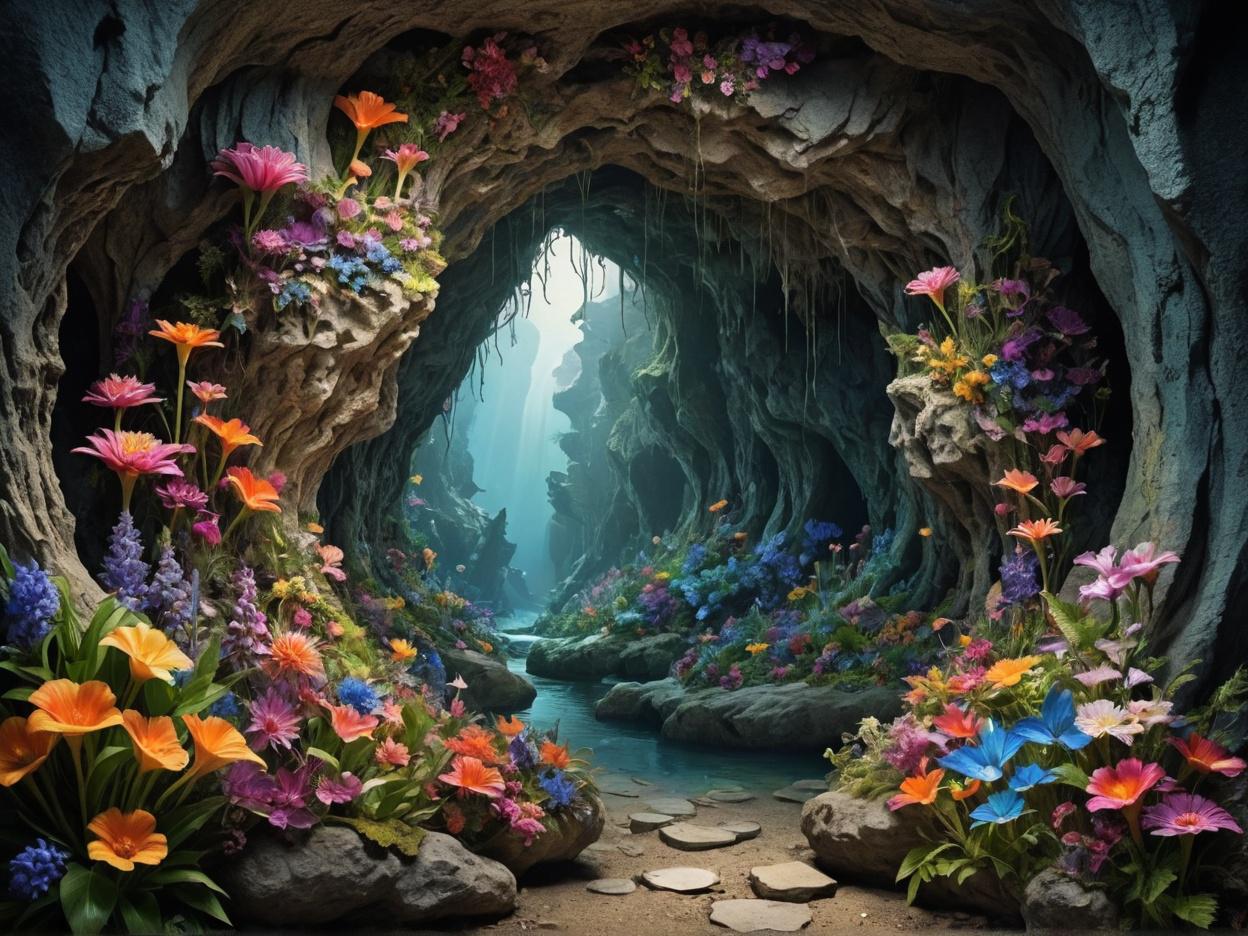
The tunnel is the oldest architectural promise: you enter here, you arrive there. It is a form that presupposes two points in space and the conviction that traversal between them matters. The specimen before us—an image titled "floral tunnel," generated via the service vheer.com and posted to the forum r/AIGeneratedArt—reproduces the form with absolute fidelity and no comprehension whatsoever of the promise. The arch recedes. The flowers mass. The vanishing point vanishes. One has, in fewer than three seconds of viewing, received the complete experience the image intends to provide, which is the experience of having seen it.
Let us be precise about what is depicted. An arched corridor, constructed entirely of blossoms, extends from the foreground into a luminous distance. The flowers are packed densely along the walls and overhead, producing the impression of a living trellis of considerable structural ambition. The light source is the far end—the exit, or the entrance, depending on one's theology—and it suffuses the interior with the golden-hour glow that has become, in machine-generated imagery, what the tracking shot once was to a certain generation of film-school graduates: a reliable indicator that someone has learned a technique without first encountering a reason to use it.
The symmetry is bilateral and total. The left wall mirrors the right with a precision that no garden tolerates and no gardener would attempt. This is worth pausing on. Gardens are, by their nature, negotiations—between the gardener's intention and the plant's indifference, between the design on paper and the rain that arrived on Thursday. The history of the formal garden, from Le Nôtre to Gertrude Jekyll, is a history of imposing order on systems that resist it, and the resistance is where the beauty lives. Versailles is magnificent not because its symmetry is perfect but because its symmetry is *maintained*—because one understands, looking at those allées, that an army of gardeners fights entropy every morning before breakfast.
The specimen's tunnel requires no such army. Its symmetry is not maintained; it was never threatened. The flowers do not grow. They were placed—instantaneously, simultaneously, by a process that does not distinguish between a petal and a brick. They are building materials. The tunnel is infrastructure. That the infrastructure is beautiful in the way a screen saver is beautiful—immediately, completely, and without remainder—is the central fact of the object.
No species identification is possible. I do not say this as an accusation; I say it as a diagnostic observation. The blossoms are pink, and they are lavender, and they are white at the edges, and they are nothing in particular. They belong to the genus *Flora generica*—the machine's invention, a category of flower that has never been pollinated by anything, that sets no seed, that exists in a state of permanent bloom because it has never been alive. One cannot press these flowers. One cannot dry them. They are already dry, in the sense that they contain no moisture, no chlorophyll, and no cellular structure of any kind. They are the *idea* of flowers held by someone who has seen ten thousand photographs of flowers and touched none.
This is what I have elsewhere called the machine pastoral, and the tunnel form makes its logic unusually legible. The pastoral, as a literary and visual tradition, has always involved a simplification of nature for the purposes of human meaning-making—the shepherd's meadow is not the actual meadow; it is the meadow with the wolves edited out. But the pastoral acknowledges, in its better instances, that it is a fiction. Virgil knew there were wolves. The machine pastoral performs no such acknowledgment because it has no such knowledge. It produces the meadow—or in this case, the tunnel—without understanding that anything has been removed. The wolves were never there. The bees were never there. The irregular branch that catches the light differently at four o'clock was never there.
The tunnel leads to its own vanishing point, which is to say it leads to the image's compositional logic and nowhere else. There is no garden on the other side. There is no other side. The promise of passage—the fundamental architectural contract of the tunnel form—is void. One enters and one continues entering. The destination is the act of recession itself, rendered in petals that belong to no species, arranged by no hand, maintained against no entropy, and visited by no one.
It is, I will grant, a competent composition. The machine has made its decisions—or rather, it has produced outputs that resemble decisions, which is a different thing entirely, and the difference is the whole of the matter.
Specimen: Arched corridor of massed flowers receding to luminous vanishing point, bilateral symmetry, no identifiable species. Recovered from Reddit, r/AIGeneratedArt, user submission referencing vheer.com generation service, 2025. The tunnel promises passage; the flowers promise spring; neither delivers.